

















Cosmic dust from shooting stars, not Venus itself, is responsible for a puzzling haze layer beneath the planet’s sulfuric acid clouds, new research reveals.
At AQN, we like the odd, distracting flight of fancy into hitherto uncharted air quality realms, so imagine our joy when, having published a story on Venus’s air pollution earlier this month, we came across more research into the Venusian atmosphere, this time from a team at Tohoku University.
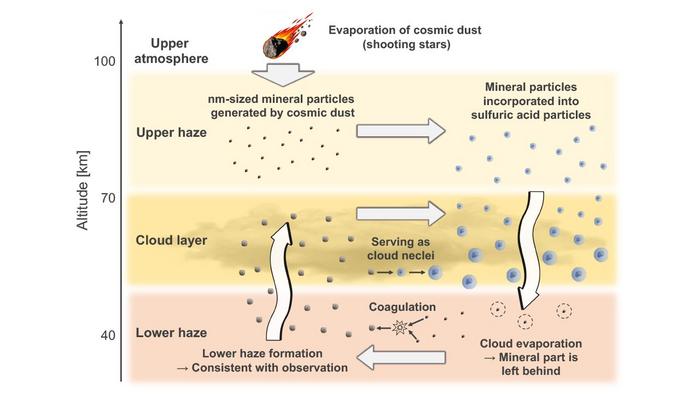
The formation mechanism of the lower haze. Cosmic dust entering from space is incorporated into sulfuric acid clouds. As sulfuric acid evaporates at the cloud base, the dust particles remain and coagulate to form the lower haze.
Scientists have finally cracked a five-decade-old mystery about Venus. Often described as Earth’s twin, the planet is better known for its crushing surface temperatures and clouds of sulfuric acid. But for more than 50 years, researchers have been puzzled by a layer of particles lurking below 47 kilometres in altitude, known as the ‘lower haze.’ First detected by spacecraft in the 1970s, its origins have remained stubbornly unclear.
A team led by Hiroki Karyu, Takeshi Kuroda, and Naoki Terada of Tohoku University, working with the Royal Belgian Institute for Space Aeronomy, has now identified the source. Using an advanced microphysical model, they demonstrated that the haze comes from cosmic dust – tiny remnants of ‘shooting stars’ that constantly fall onto Venus.
‘When we traced the life cycle of these particles in our simulations, everything suddenly fit together,’ said Karyu. ‘Cosmic dust, which might seem insignificant, turns out to be the missing ingredient needed to explain Venus’s lower haze.’
The study shows that incoming cosmic dust burns up high in the atmosphere, producing nanometre-sized mineral particles. These become trapped inside Venus’s sulfuric acid clouds. As they sink into the hotter lower atmosphere, the acid evaporates, leaving behind solid mineral cores. Those cores then collide and merge, forming the haze layer observed by old missions like Venera and Pioneer Venus. The model’s results align closely with measurements taken decades ago, giving strong support to the team’s explanation.
The researchers also discovered that these cosmic particles influence Venus’s climate by acting as seeds for cloud formation, increasing cloud production by an estimated 20% to 30%. The team further suggests that metallic elements in the dust, including iron, may explain the long-mysterious “unknown UV absorber” in Venus’s atmosphere – a substance that strongly absorbs sunlight and affects the planet’s energy balance.
Terada said: ‘These findings show that material from space is not just a passive visitor. It can actively shape a planet’s atmosphere and climate.’
The research suggests similar processes could occur on Jupiter, Saturn, and even distant exoplanets. The team hopes to test its predictions with future missions, including NASA’s DAVINCI mission to Venus, scheduled for launch in the late 2020s.
The research can be accessed here
Ilustration: Hiroki Karyu et al
Photo: Zelch Csaba
Leave a Reply