















The world’s largest wind–solar co-located project is now operational on the Loess Plateau in northwest China, marking a significant milestone in the evolution of large-scale renewable energy systems.
With a total installed capacity of 6 GW, made up of 4.5 GW of wind and 1.5 GW of solar, the project delivers more than 12 TWh of green electricity annually. This clean power is transmitted via ultra-high-voltage (UHV) lines to key industrial regions along China’s eastern coast, helping to decarbonise some of the country’s most energy-intensive areas.
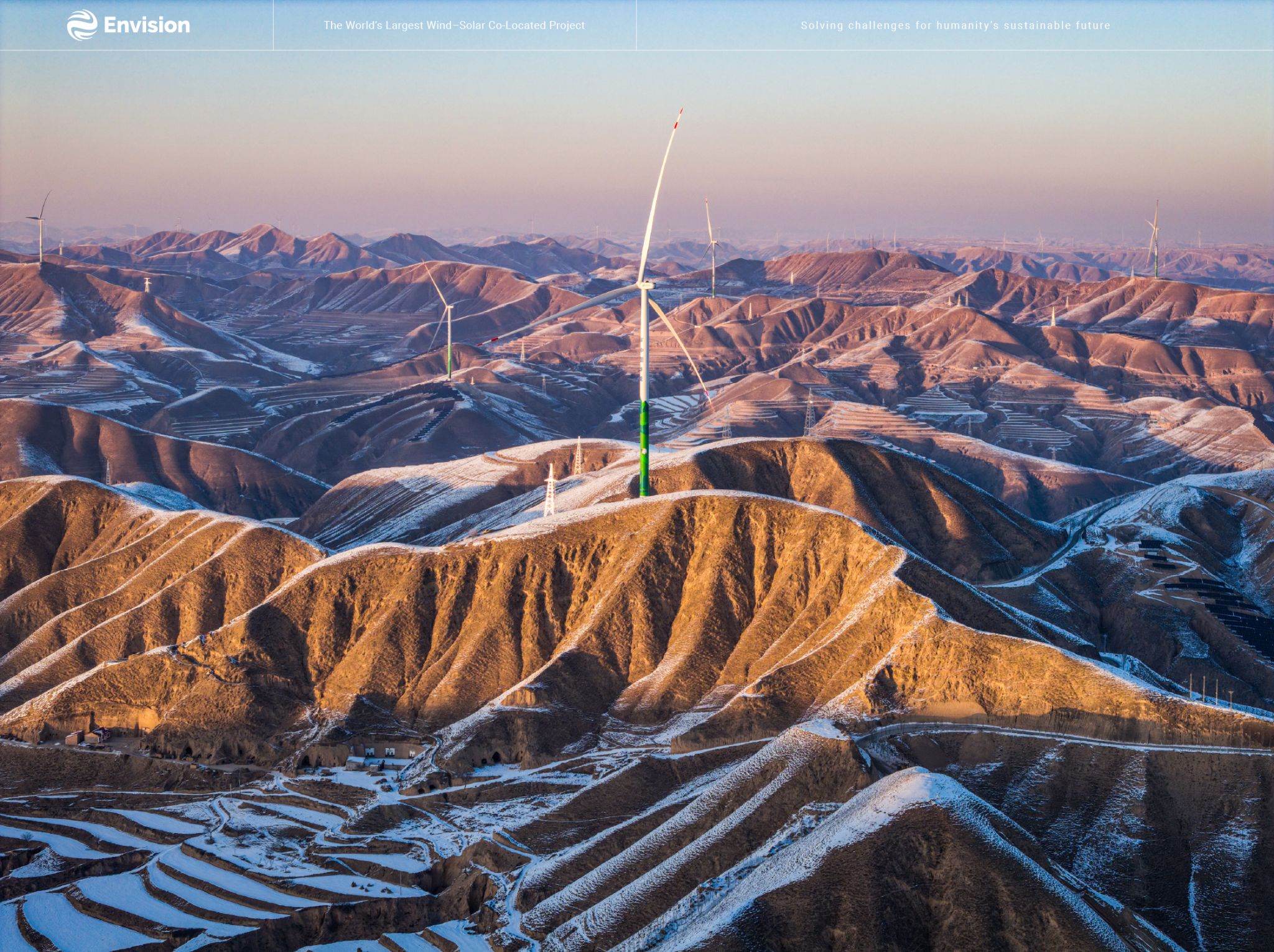
What makes this achievement particularly remarkable is not just its scale, but the complexity of its environment. The Loess Plateau, characterised by rugged valleys, desert fringes, and highly variable wind conditions, presents formidable logistical and engineering challenges. Limited construction windows and difficult terrain demanded a highly coordinated, efficient, and adaptive approach to execution.
Envision Energy, who supplied the turbines, addressed these challenges through three core capabilities:
Tailored turbine and technology solutions
The deployment of customised EN-200/5.56 MW turbines was central to the project’s success. Designed specifically for low-wind, mountainous environments, these turbines feature larger rotors and higher capacity, enabling greater energy capture while reducing the total number of turbines required. This not only streamlined installation but also accelerated overall project delivery.
Advanced supply chain and organisational execution
Executing a project of this scale in such terrain required seamless coordination across multiple manufacturing and logistics hubs. Envision Energy orchestrated the transport of massive 99-meter blades through narrow, winding mountain roads—an operation demanding precision planning and real-time coordination. This capability ensured that materials and components arrived on-site efficiently, minimizing delays.
Extreme-condition delivery capability
To meet tight construction timelines, the project implemented a 1:1 allocation of transport and lifting equipment per turbine. This allowed for continuous installation over an approximately 150-day window. Additionally, single-blade installation techniques enhanced flexibility and efficiency, particularly in constrained or uneven terrain.
Once considered a harsh and resource-limited region, the Loess Plateau is now being redefined as a cornerstone of China’s renewable energy future. This project not only demonstrates what is technically possible but also sets a new benchmark for integrated, large-scale clean energy deployment in challenging environments.
Leave a Reply