

















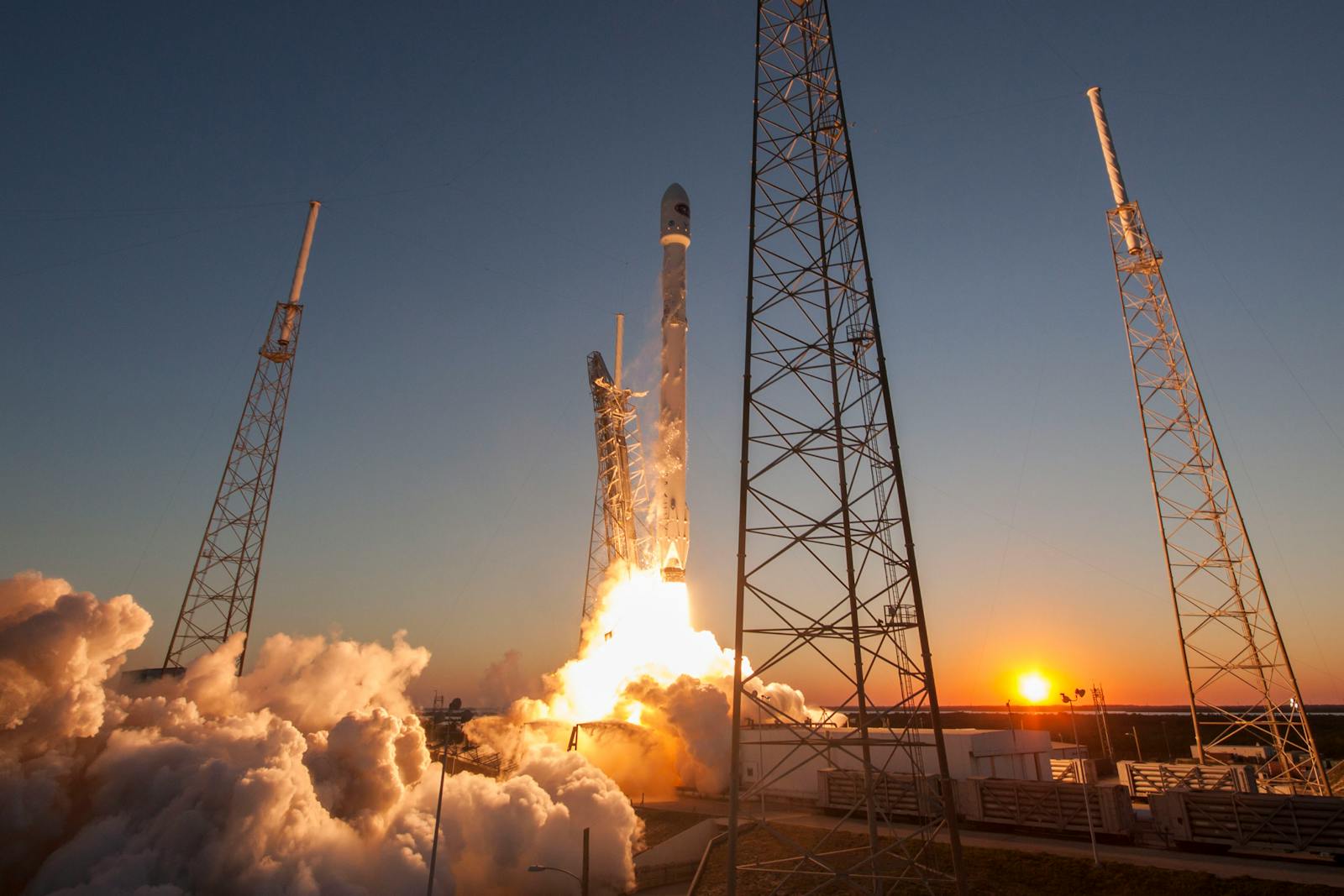
New research has found that when a Falcon 9 rocket stage burned up over Europe last year, it left a plume of lithium pollution in the upper atmosphere – the first time scientists have directly measured the chemical footprint of re-entering space debris.
The study confirms that material from the disintegrating rocket travelled nearly 1,600km before being detected by a ground-based laser system in northern Germany, approximately 20 hours after the event.
A team of researchers at the Leibniz Institute of Atmospheric Physics in Kühlungsborn were operating a resonance lidar – a sophisticated laser tuned to detect trace metals – on the night of 19th February. Just after midnight, their instruments recorded a tenfold spike in lithium atoms at an altitude of 96km.
The plume was tightly confined between 94.5 and 96.8km, lasting about 40 minutes before observations ceased. Background lithium levels were around three atoms per cm³ during the plume, before jumping to more than 30.
The authors hypothesised that the plume might be linked to the Falcon 9 re-entry event, so to test this, they used advanced atmospheric models to calculate backward trajectories, simulating where the air over Germany had come from hours earlier.
The results pointed to a precise location: a stretch of sky west of Ireland, at 100km altitude, at 03:42 UTC – exactly when and where the Falcon 9 upper stage was making its uncontrolled re-entry. The match was within 2km vertically and 10km horizontally.
Lithium is not abundant in nature – the daily influx of lithium from meteoroids is estimated at just 80 grams globally. A single Falcon 9 upper stage, by contrast, contains around 30 kilograms of the element, used in advanced aluminium-lithium alloys for tank walls. When the rocket began to break up at around 98km, that lithium vapourised and spread across the upper atmosphere.
The researchers systematically ruled out natural explanations. There was no significant geomagnetic storm that could have driven lithium downward from higher altitudes. Wind patterns did not favour the formation of a concentrated metal layer. The only plausible source was the rocket itself.
With tens of thousands of satellites planned for mega-constellations like Starlink, and rocket stages re-entering regularly, the cumulative mass of artificial material burning up in the atmosphere is set to rise dramatically. Projections suggest that within decades, the flux from human-made debris could exceed 40% of the natural meteoroid influx.
Unlike meteoroids, which are composed largely of chondritic minerals, spacecraft introduce exotic materials such as aluminium, lithium, copper and rare earth elements from electronics. These metals can seed aerosol formation, alter stratospheric chemistry and potentially affect ozone. The long-term consequences remain unknown.
The authors conclude: ‘This study presents the first measurement of upper-atmospheric pollution resulting from space debris re-entry and the first observational evidence that the ablation of space debris can be detected by ground-based lidar.’
They also stress that more observations and atmospheric modelling are needed to understand the long-term effects of these pollutants on the atmosphere, warning that the volume of upper atmosphere pollution is likely to rise given the sharp increase in orbital launches over the past decade.
The full research can be read here
Photo: SpaceX
Leave a Reply