

















Dr Peter Knapp – air quality scientist, journalist and filmmaker – provides a damning response to the Government’s Environmental Improvement Plan, which was published yesterday.
 The important and necessary steps for the Government is to reduce the sources of air pollution. I outline eight areas and how the Government Plan has addressed them.
1. Adopting WHO guidelines
Back in 2021, the World Health Organization has set guidelines for the main air pollutants. The European Union has weaker targets and, prior to this report, the UK had weaker targets still. The new report states that the UK will align with EU targets by 2030, rather than with the WHO guidelines set 4 years ago.
Here is a table of the annual averages (or *daily 8-hour mean), in units µg per metre cubed:
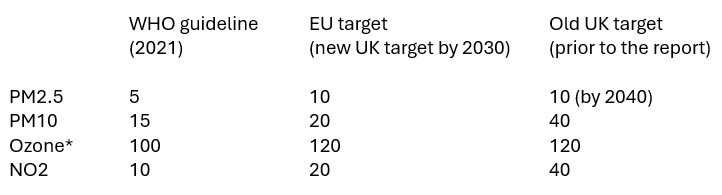
As you can see, none of the WHO guidelines set 4 years ago are even considered as UK targets by 2030. This is not adequate to save lives and will lead to greater numbers of deaths from air pollution than stronger targets would.
2. Reducing meat and dairy
Each spring, the UK’s air is polluted by particles that come from animal agriculture in the Netherlands. Ammonia from farming cattle, chickens, and pigs reacts with nitrogen dioxide from boilers and car exhausts to make particles of ammonium nitrate.
The Netherlands has one of Europe’s largest livestock industries, with more than 100 million cattle, chickens and pigs. The Netherlands is also the EU’s biggest meat exporter.
The UK imports a huge amount of chicken from the Netherlands ($661M), so our consumption of these animal products is contributing to the air pollution we suffer.
The report acknowledges the impacts of polluting agricultural practices, but fails to incentivise lower consumption of these products. Instead, it uses diversionary and blaming language such as ‘Air pollution is a transboundary issue, and we must act internationally to further improve air quality in the UK’.
This is not just an issue from the Netherlands, however. The UK is reportedly on track to miss its own 2030 ammonia emissions reductions target and is likely to face legal challenges from environmental health campaigners. More information on this here.
The report attempts to reduce ammonia through changing various practices such as using slurry covers, which will aim to reduce ammonia by a small 16%, but this does not reduce the source of emissions. Reducing our consumption of these products is the real solution, which would make much greater reductions in ammonia emissions, but there is no attempt by the Government to do this.
3. Reducing aviation
One of the main issues of air pollution from aviation are ultrafine particles, or UFPs. Concentrations at the end of runways are measured at 10 million particles within each cubic centimetre.
The gases coming from plane engines react in the air to form UFPs that plague towns and communities living near airports. The UK Government lists only four monitoring stations across the country and none of them are near UK airports.
UFPs from airports were shown to reduce lung function and increase airway inflammation in individuals with asthma. You can see my speech to the Gatwick airport expansion planning inspectorate that expands on these points here.
The UK Government’s new plan does nothing to reduce aviation. Instead, they gave a green light to Luton airport expansion and £2.4 billion of taxpayer money to do so, coinciding with the UK Government’s grant to a new Disneyland nearby.
The report says they aim to ‘increase the uptake of sustainable aviation fuels (SAF) to 10% by 2030’, but the latest research says that even 100% SAF would reduce the number of particles by only 20-40%, and therefore plan’s target of 10% would reduce the number of particles by just 2-4%.
There are many, many reasons why SAF is not a solution to the many issues around aviation, which can be explored further here. The real solution is to reduce flights, and the UK Government have chosen to expand aviation and use technofix solutions rather than tackling it at source.
4. Reducing car traffic
Most of the particulate air pollution from our roads is in the form of resuspended road dust from tyre and brake wear, and not from tailpipe emissions. The only way to reduce this is by reducing the number of cars on the road.
The new report says that they will ‘Ensure 80% of new cars and 70% of new vans sold in the UK will be zero emission by 2030, with 100% of new sales zero emission by 2035, supporting reductions in air pollution and CO2 emissions from road transport by 2030.’
This does nothing to reduce the numbers of cars, and the many issues other around space, road deaths, and embedded emissions and minerals needed in car manufacturing. It also conflates zero tailpipe emissions with resuspended road dust, misleading the public that electric vehicles produce no emissions when they most certainly do.
We welcome the roll-out of electric buses, however, when they ‘Support transitioning to a zero-emission bus (ZEB) fleet, including by working with the Bus Manufacturing Expert Panel to develop a clear pipeline of future orders by November 2025’.

5. Reducing shipping
Poor air quality due to international shipping accounts for approximately 400,000 premature deaths per year worldwide. This is from the sulphur, nitrogen and black carbon from burning low-grade fuel. Shipping remains the least regulated transport sector regarding air pollution.
The sulphur dioxide and nitrogen oxides are both major drivers for acid rain and particulate pollution, and although low-sulphur fuels are encouraged, these marine fuels will still account for ~250,000 deaths and ~6.4 million childhood asthma cases annually.
We have got ourselves into a bit of a mess though, where recent efforts to reduce air pollution from shipping reduced the sulphate particles that were providing a cooling effect, and cleaning shipping fuels led to a 3% increase in global heating.
The report responds to this by saying they will ‘reduce domestic shipping fuel lifecycle greenhouse gas emissions by 30% by 2030’, not by reducing the demand for shipping by reducing our consumption of imports, but by throwing £448 million at ‘research and development funding to accelerate technologies necessary to decarbonise the domestic maritime sector’ that has no proven outcomes and kicks the can down the road.
6. Reducing incinerators
Once exported plastic waste is included, the UK has the second-highest per capita rate of plastic consumption in the world after the USA. Until the mid-1990s, the UK sent 90% of waste to landfill, but the methane and toxic chemicals released were catastrophic for the environment. Rather than looking for ways to meaningfully reduce waste, the UK has either exported waste to low- and middle-income countries (where it has been found dumped and burned near beaches and rivers) or burnt it.
There is big money in burning waste and it has been described as ‘energy recovery’ in ‘ecoparks’ to make it seem beneficial to the public. Although incineration provides 2% of the UK’s electricity, this method produces 30% more CO2 than burning gas and will be the dirtiest form of electricity generation in the UK once coal is phased out.
Air pollution from incinerators is not well researched or documented, but hazardous chemicals such as polychlorinated biphenyls (PCBs) and polybrominated biphenyls (PBBs) are formed when waste is burnt. If combustion takes place at temperatures of about 850ºC, any dioxins already formed are destroyed, but can re-form again post-combustion, and it is not guaranteed that incinerators maintain this high temperature.
There is a lack of adequate regulation and enforcement on incinerator plant operators, and Greenpeace reported “no incinerator currently operating in England is able to meet the legal requirements of its license (sic)”.
The real solution to reduce air pollution from waste is to reduce waste generation, but the UK Government is instead rolling out more incinerators to pursue economic growth. The report says they are ‘determined to improve economic growth’ by ‘turning waste into economic potential’.
A token effort to reduce consumption is considered by ‘changing packaging and product design, keeping products and materials in circulation for longer, and making it easier for people to segregate and recycle their waste’.
7. Enforcing regulations on wood burning
The report recognises ‘the burning of solid fuels is a large contributor to national emissions of fine particulate matter (PM2.5) and is a major source of air pollution, especially in urban areas’.
But the only part of the report focused on this is that they will ‘consult on new measures that cut emissions from domestic combustion’.
Currently, wood burning from stoves that aren’t Defra approved in Smoke Control Areas (SCAs) is illegal, but violations of this are almost impossible for anyone to report, or to have enforced. Even open fires in pubs or wood-fired pizza ovens in Clean Air Zones are not typically pursued by local authorities, where they need to be called out and then physically observe the contravention multiple times before serving fines.
Areas outside the SCAs have a much harder time, where people suffering much greater levels of smoke from neighbours burning solid fuels using high-pollution methods have no recourse. The map of where these areas lie can be found here.
The report does nothing to address the expansion of SCAs, enforcing them, the ultrafine particles coming from so-called Ecostoves, or financially supporting people who currently rely on this form of heating to move to cleaner alternatives.
8. Indoor air quality support
In general, the approach to ‘tell people to stay indoors’ rather than ‘stopping the air pollution sources’ on polluted days is persistent in this new report, as they plan to ‘launch a new air quality alert system by March 2026 to provide advanced warning of pollution to the people who need it most’.
However, as people already spend over 90% of their time indoors, with many now working from home, there is no mention of improving air quality in these areas. The word ‘indoor’ doesn’t even appear in their plan.
- Measures to reduce exposures to indoor air pollution could include:
- Subsidising induction or electric hobs to replace gas hobs;
- Subsidising extraction hoods above cooking stoves;
- Providing air quality monitors and cleaners for people suffering with respiratory health conditions so that they can reduce their exposures to triggers;
- Banning the use of solid-fuel appliances in all areas where alternative forms of heating are accessible, and providing funding to those who don’t; and
- Public information campaigns about dangers of drying clothes indoors, incense burning, or safer cooking practices, and the importance of ventilation and ways to do this in cold weather without losing heat.
Omissions of any reference to indoor air quality demonstrates how blind the Government is to the main exposures of air pollution that people suffer.
Overall
Even though the report starts by saying ‘air pollution remains one of the biggest environmental threats to human health, and continues to cause damage to the environment’, the report fails to address meaningful action on any of the eight key points required to reduce air pollution exposures in the UK.
By framing growth of the economy as God with the clumsy phrase ‘It is essential to growing the economy’, the opportunities to meaningfully reduce air pollution, carbon emissions, and pollution within timeframes that will save lives and avoid the worst impacts of climate catastrophe and human rights abuses are severely limited.
The report reflects a government who is more focused on the economy that public health, the environment, human right, or climate change.
Pete has recently changed from academia to filmmaking and, having just finished his first film ‘Fires and Fascism’, he is touring the UK to show it in community & independent cinemas, halls, and universities.
The film is about how wildfires in southern Europe link to more than just climate change, but also big business, organised crime, and the far right; and how community action provides unity in times of growing division. More info and screening dates: www.fires-and-fascism.co.uk
Photo: Chris LeBoutillier / pexels
Leave a Reply