


















A new study has, for the first time, measured exactly how much urban parks cool the air, reduce pollution and lower noise levels with every step a person takes away from a busy road.
Researchers from the University of Surrey’s Global Centre for Clean Air Research (GCARE) carried out high-resolution mobile monitoring at Stoke Park in Guildford, one of the largest green spaces in the centre of the town. Using backpack-mounted sensors, they measured air temperature, particulate pollution, carbon dioxide, noise and thermal comfort during morning, afternoon and evening walks over several summer days.
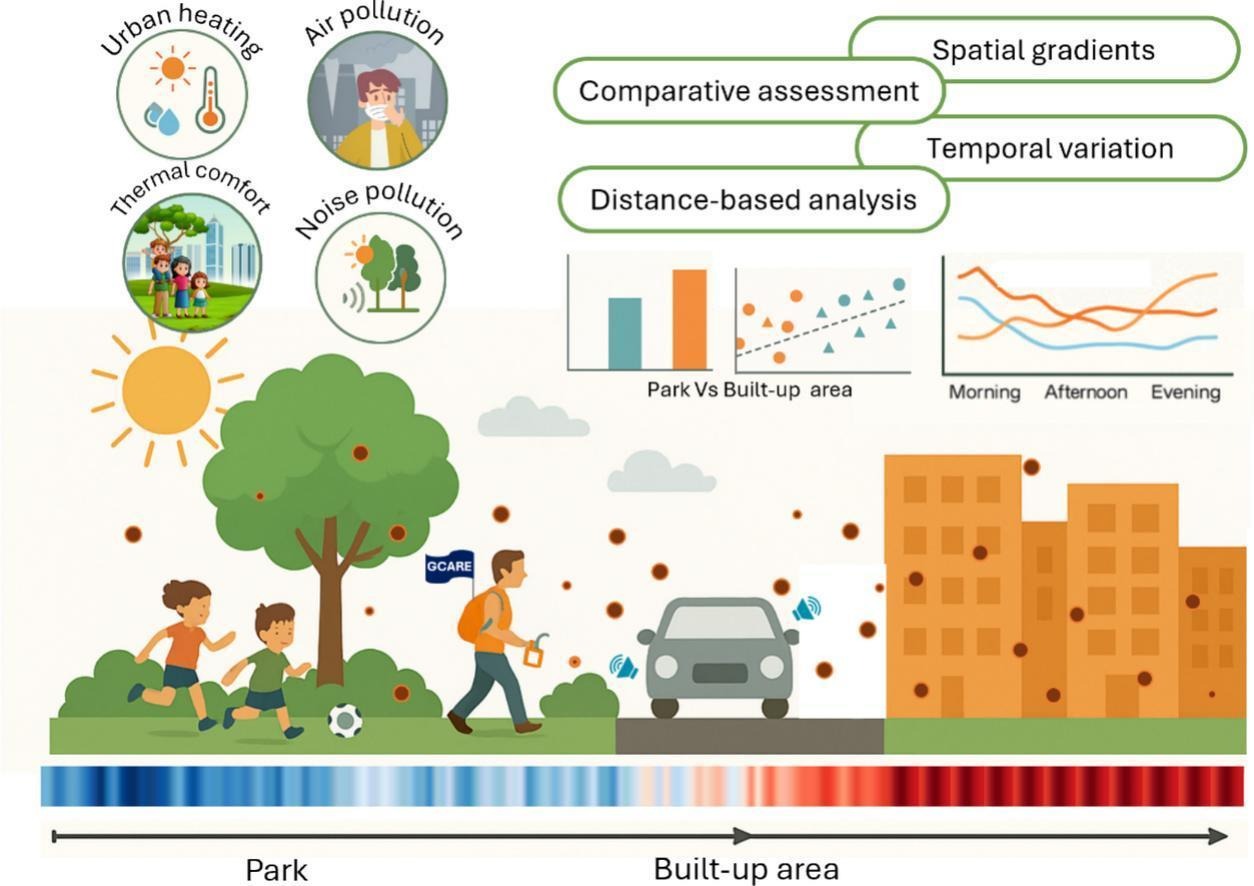
The findings offer precise, practical data for city planners and landscape architects. The study found that for every 100 metres walked from the edge of the park toward its centre, air temperature dropped by 0.2°C.
In the opposite direction – moving from the park boundary into the surrounding built-up area – temperatures rose by more than 0.5°C per 100 metres, a cooling influence that extended up to 300 metres from the park.
Noise levels fell even more dramatically. Sound pressure dropped by 3.4 decibels per 100 metres moving away from roads into the park. Within the park itself, noise decreased by 5.4 decibels per 100 metres – a steeper decline than in built-up areas, thanks to soft ground, vegetation and uneven terrain.
Particulate pollution showed a different pattern. In the evening, concentrations of PM10, PM2.5 and PM1 increased by 1.63, 0.17 and 0.2 micrograms per cubic metre respectively for every 100 metres from the park edge into the built environment. This suggests that during stable evening conditions, parks act as effective filters, trapping fine particles.
Thermal comfort also varied significantly depending on where people stood. Under tree shade, the physiological equivalent temperature – a measure of how hot the body actually feels – was 8.5°C lower than in nearby built-up areas during the afternoon. Open grassland provided a 4.5°C reduction. Trees proved consistently more effective than grass at reducing heat stress throughout the day.
The research also revealed important trade-offs. Cooling benefits did not always align with cleaner air. In the morning, areas with the strongest cooling sometimes showed higher particle levels, particularly near roads bordering the park. By afternoon, these relationships weakened, and in the evening, synergies re-emerged for larger particles.
Professor Prashant Kumar, Founding Director of GCARE and corresponding author of the study, said: ‘Our work shows that parks can bring measurable cuts in heat, pollution and noise both inside parks and across surrounding neighbourhoods. This provides stronger evidence for planners and policymakers looking to design healthier and more climate-resilient towns and cities.’
The authors recommend that walking routes inside parks be designed to maximise time in tree-shaded cores, and that urban planners use distance-based evidence to design greener, quieter and cooler neighbourhoods.
Soheila Khalili, Postgraduate Researcher at the University of Surrey’s GCARE, said: ‘This is proof that the benefits of parks extend far beyond their boundaries. Shaded areas with trees particularly improved thermal comfort during hotter periods of the day.
‘Cities are having to adapt more and more as the climate continues to warm, so understanding exactly how parks improve environmental conditions can help guide more effective urban design.’
The full research can be read here.
Photo: Oxana Lyashenko
Leave a Reply