












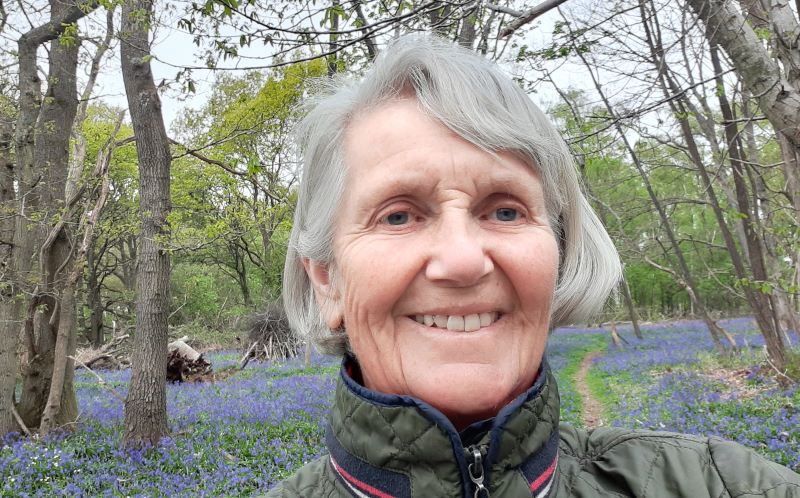
Professor Helen ApSimon played a pivotal role in making the west aware that a nuclear accident had occurred a Chernobyl in 1986. She has also worked on acid rain and is currently Professor of Air Pollution Studies at Imperial College London.
Emily Whitehouse speaks to her about her career.
I read about your experience of the air quality in Northampton as a child – being in the car with your parents and being unable to see out. Did this influence your decision to pursue a career in air quality?
I think later on, air pollution meant something to me because of that. So yes, I think it did, although by the time I took off in my air pollution career, those fogs had been dealt with or largely dealt with.
Earlier in your career, you worked alongside Jocelyn Bell Burnell [who discovered the first radio pulsars in 1967]. What was that experience like?
Well, we shared an office. We were both down at Southampton University for a time and I’d done astrophysics as my PhD and she obviously had done all her work.
I admired what she’d done, and I was very aware that it was her work, not her supervisor’s. He got the Nobel Prize and she did all the work, but she was interviewed on the radio the other day and I thought she gave a very good answer because she said, ‘well, if I had been given the Nobel Prize, I would not have been given all the other awards that I’ve been given since, which have been very nice.’ I thought that was a lovely way of answering it.
You recently said mentioned that Jocelyn felt she was taken less seriously because she was a woman. Do you think this women in the sciences suffered this disproportionately or was it kind of typical of the time?
I think it depended where you were. I mean, I think Imperial College overall was fine, but I think at that time, engineering particularly was rather a man’s field. There were very few women in universities in it. So you got the odd person that really didn’t think women were perhaps very capable.
Jumping forward to today, do you think you’ve noticed a change in opportunities for women in science?
I think now the problem has reduced tremendously. There’s so many more women in science. I mean, in my own centre, we’ve probably got more women than men. But I don’t see evidence that way.
And of course, we’ve had so much emphasis recently on gender equality and the college is really onto it. So it’s stamped out pretty hard if it occurs, I think.
You have said that you fell into air pollution research. Looking back, do you think there was a particular moment where you realised that this accidental career has become your life’s work?
I don’t think so. I think when I moved to Imperial College, I’d become a modeler. And computer modelling can be applied to a great variety of things.
I wasn’t really happy just working on the nuclear engineering. It seemed to be modelling flows around ducts and looking at radioactive drains and things like that. And I was much more interested in the natural environment.
And so it was just an opportunity, and I was rather taken under the wing of Barry Smith at the Met Office, who gave me wonderful help on learning about meteorology and air pollution. And then we got the opportunity to work with the EU on a contract looking at effects of a nuclear accident on a neighbouring country. That was why we built the model in the first place.
So it was that incident really that led me into air pollution. And I was very happy about it because I love being outside and understanding air pollution.
Helen played a pivotal role in the immediate aftermath of the Chernobyl disaster in 1986 . As Russia imposed a media blackout, she was one of the few European scientists to detect rising radiation levels . She used computer models to analyse the dispersal and deposition of the radioactive release across Europe, calculating that the release included significant amounts of Iodine-131 and caesium-137, and tracking the radioactive plume’s movement over Scandinavia and the North coast . Her work was instrumental in assessing the accident’s consequences and advocating for combining modelling with radiological measurements for emergency response .
You played an important role in responding to the Chernobyl disaster. Looking back, do you think your career had placed you in the right position, at the right time?
Very, very much so. That was a very lucky thing for me. I’d already been looking at nuclear accidents, and then all this data came in saying there had been one. The Met Office were incredibly helpful. Barry Smith, who had been my mentor there, provided all the weather data and everything I needed.
We just ran the model. So we were in the right place at the right time. Although, it was a very simple model, and I can be very critical of it now.
How would you be critical of it?
Well, computing and modelling has moved on. Everything is much more sophisticated now, it was a very simple thing – it looked at where were the winds going, where would the trajectory have gone. Imagine some kind of box moving along that trajectory and what happened to the pollution.
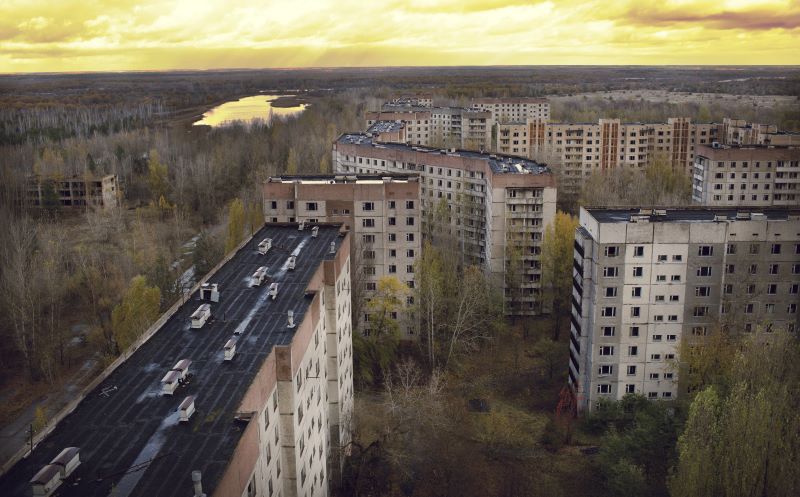
You visited Pripyat [above] after the disaster, that must have been an extraordinary experience.
Very, very weird. I shall never forget getting off that coach. We got off by a children’s playground, and it was just absolutely empty with little scraps of the residue of where they tried to clear away the pollution and roll it up in a kind of foam.
There were creaking children’s swings in the playground. It was really eerie. And then we walked around the town, and they just had to throw out all the food and things that they’d found in people’s flats to try and get rid of the rats and all that kind of thing.
It was a really strange experience. It made you think of what the aftermath of nuclear war or something like that would be.
Another highlight of your career was your work on acid rain. You said that because the UK was a major culprit, it was sometimes difficult. What did you mean by that?
The problem was taken up by OECD and then over by the UN Economic Commission for Europe, because it was a European issue. There was very strong representation from the Scandinavian countries, which were particularly affected. Of course, with the prevailing winds, it was largely our pollution that was causing a lot of the acid rain.
So, one was slightly, well, on the defensive, I suppose. People feeling that when we were putting forward our own modelling, was it biased? But I think it was good that we were accepted. And they listened to our modelling, and we all worked together and it worked out okay.
The battle of acid rain was such a huge success. Do you think we perhaps underestimate how much of a success it was?
I think so. And I think we have to give credit to IIASA [International Institute for Applied Systems Analysis] because they played a very major role in this and continue to play a major role in the work of the UNECE, which is still continuing and has expanded to a much wider range of pollutants. But yes, I mean, I think there are differences comparing with climate negotiations.
We had fewer models. Eventually, we gave the lead to the IIASA model, and the other countries just tried to add their own national picture where they had a lot more detail. So I think that worked.
We have got the divide now between Russia and the countries under the Russian domain and the ones that have made the transition to Europe.
And that was a very interesting phase, seeing those countries change, countries like Poland. And that’s where I was really lucky in having a Churchill Fellowship to go around and visit those countries that were making these huge transitions.
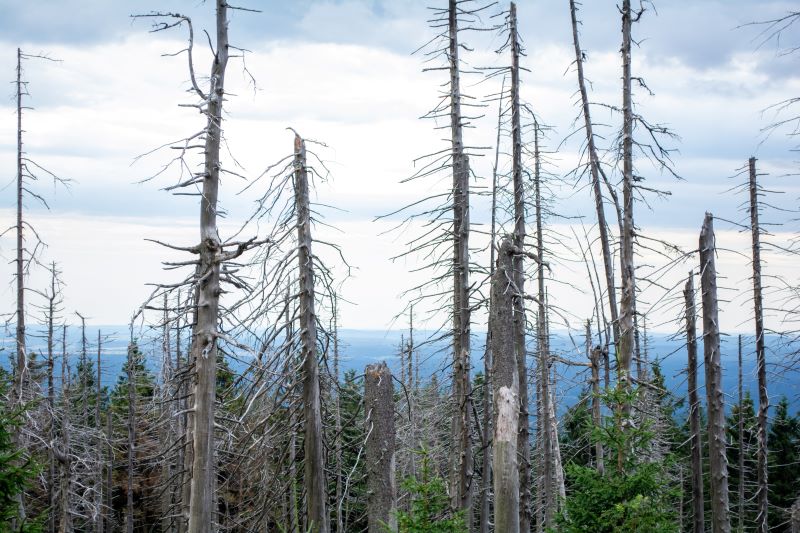
Helen made significant contributions to acid rain research through scientific modelling and policy assessment. She led the first major integrated assessment of acid rain’s environmental and economic impacts across Europe, published as “Acid Rain in Europe: Counting the Cost” in 1997. Working under the UN ECE Convention on Long-Range Transboundary Air Pollution, she developed cost-effective reduction strategies and modelled pollutant dispersion, providing crucial evidence for policy development and damage cost calculations.
How did you find visiting these countries?
I had a wonderful time. But the stupid thing was I was talking about the Chernobyl accident in all these countries, which seemed a bit ridiculous. But they were all anxious to tell me what data they got and all that kind of thing. But the idea was to set up a European association where we could talk to each other. So the scientists from Eastern Europe could talk to us in Western Europe.
That idea was really welcomed, and I had a really good time working with this association. They were all competing with each other to give the best conference. It was really great.
Throughout your career you’ve met a wide range of fascinating people, from Soviet scientists to political reformers in Eastern Europe. Who has left the biggest impression on you?
Oh golly, it’s difficult to choose one person. I can give you one example. When I went to Poland, Maciej Nowicki, who is still a friend actually, was a founder member of Solidarity. When I got to Poland, he was the person that welcomed me at the airport and then took me around Poland.
He’s got a tremendous knowledge of history as well as his interests in air pollution. He subsequently became their environment minister after the changes, and he hosted the climate meeting in Poland.
We had lovely experiences in Eastern Europe. We had an EU grant to bring people together and work on air pollution and acid rain and things. At the first meeting, which was held in Poland, all the groups came and sat separately, and they stuck me on a chair on a high table at the top. The first thing I did was to get down and move down between them.
Even within the country, the institutes did not talk to each other. You know, they were all sort of sitting very, very separate. So, it was a cultural thing of trying to get people to talk to each other and feel free to cross boundaries into slightly different disciplines and all that kind of thing.
You studied astrophysics, astronomy and maths at university before moving into environmental science. Do you think any skills from those fields have bled into your work now?
Yes, it was the computer modelling, how you can use mathematics to simulate a situation. So whether you’re looking at space and what’s happening in the middle of stars, or whether you’re looking at what’s happening to our weather, it’s still the same mental process of trying to represent what’s happening in mathematical equations.
I really want to talk to you about the IAQM awards. You have had one named after yourself, how does that make you feel?
I was very honoured and wondered why me. I hadn’t heard of Dr Mary Cantterall, who also has an award named after her, so that was quite interesting to me. But yes, I felt very flattered.
The award I’ve got is one for people at the start of their career and that’s very much what I’m keen on promoting. I think the IAQM does a very good job, and I wish there were stronger interactions between universities and IAQM – anything that can encourage people in their careers.
Do you think there’s anyone in the field that deserves to have an award named after them now?
Oh golly, I couldn’t answer that one off the cuff. There are several people that are bringing out new things. But to try and pick on one, I think, is difficult. Air pollution is changing all the time. There’s a lot more emphasis, for example, on indoor air pollution, so maybe somebody from that area could be picked out.
It’s interesting you mentioned stronger interactions earlier as you’ve previously criticised scientists for speaking mainly to other scientists.
Ah, that’s not the fault of the scientists, it’s the fault of the system. In the REF [Research Excellence Framework] system, which is what universities use, all the emphasis is on papers in learned journals. There’s not equivalent credit given for really clear, less technical language explanations, which I think is important.
That’s where you do a good job, because you pick up things and put them in everyday language. But the scientists themselves are not encouraged to do that.
Looking back over your career, of everything you’ve worked on, what are you most proud of?
Wow, I don’t know. I suppose Chernobyl was something that we really worked hard on, but I’m also very much enjoying the work we do now. I have a team of six people, and there’s always something new – new problems coming up with air pollution. It never gets boring. So I think the current work, too, is something I’m proud of, as well as the people I work with.
What still excites you to get out of bed in the morning and go to work?
Post Brexit, the UK has had to make its own decisions on what we do in the environment, so that, I think, has been a big challenge. And over the last few years, I’ve established this research group in CEP and I want to see it continue and be a success. We’re planning a special unit in the college, and I hope the work will continue. That’s what gets me out of bed in the morning.
Leave a Reply