


















A groundbreaking study has turned a network of air quality monitoring stations into a powerful time machine for tracking ecosystem health.
By analysing decades of archived air filters, scientists have successfully reconstructed a weekly record of biodiversity spanning 34 years, revealing a significant decline linked to forest management.
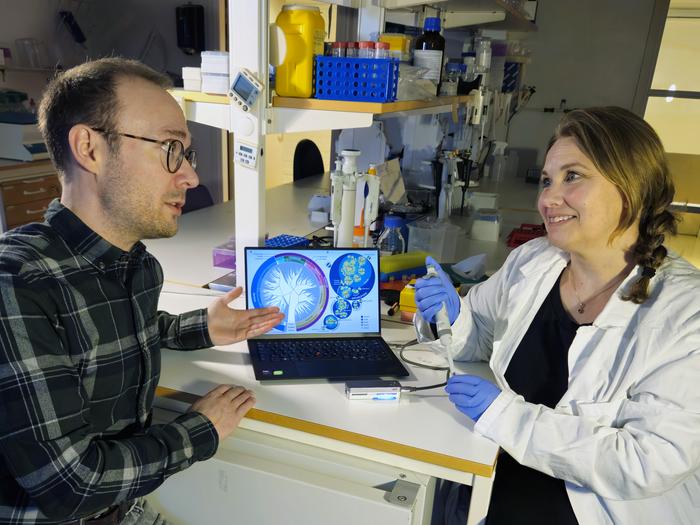
Daniel Svensson and Anna-Mia Johansson take a break from DNA extractions to discuss new results.
The research used airborne environmental DNA (eDNA) – genetic material shed by all forms of life into the atmosphere. The team focused on filters from a radionuclide monitoring station in northern Sweden, which for decades has pumped vast volumes of air (over 100,000 cubic meters per week) through fine mesh to capture atmospheric particles.
This routine air quality work inadvertently created a perfect, long-term archive of biological data. The researchers applied shotgun sequencing to 380 weekly filters stored from 1974 to 2008, recovering trace DNA that had settled on them.
Per Stenberg, lead author of the study conducted by researchers from Umeå University, the Swedish University of Agricultural Sciences, and the Swedish Defence Research Agency, said: ‘It was a stroke of luck that the filters had been kept – and that they were made of a material that preserves DNA. The archive turned out to be a time machine, allowing us to revisit the past and watch an ecosystem changing in almost real time.’
The team detected over 2,700 genera, from bacteria and fungi to plants, insects, birds and mammals. Critically, the trends in bird eDNA closely matched data from traditional wildlife surveys, validating airborne DNA as a reliable proxy for monitoring species abundance.
The long-term view exposed a major shift. Beginning in the early 1990s, the genetic signature of pine trees surged dramatically, coinciding with a period of extensive commercial forestry involving clear-cutting and replanting. As pine-associated eDNA rose, signals from a multitude of other species – including birch, spruce, feathermosses and wood-dwelling fungi – declined.
Overall biodiversity, measured as ‘gamma diversity,’ was about 35% lower in the 2000s compared to the 1970s. The study concludes that the conversion of diverse, old-growth forests into managed monocultures is the most likely driver of this regional biodiversity loss captured in the air.
This research highlights a hidden potential within global air monitoring networks. Thousands of similar stations worldwide, operating under standardised protocols to monitor radionuclides or pollutants, are continuously collecting airborne eDNA. This positions them as a ready-made, global infrastructure for cost-effective, large-scale biodiversity surveillance, capable of tracking ecological change in near real-time and reconstructing environmental history from archived samples.
Access the full report here.
Photo: Bea Andersson
Leave a Reply