


















Indoor plants may do far more than brighten a room. New research suggests they can quietly reshape the health, comfort and resilience of the buildings where people spend most of their lives.
A major international study led by the University of Surrey’s Global Centre for Clean Air Research (GCARE) finds that houseplants, living walls and hydroponic towers have the potential to raise indoor humidity, improve thermal comfort and contribute to healthier indoor environments.
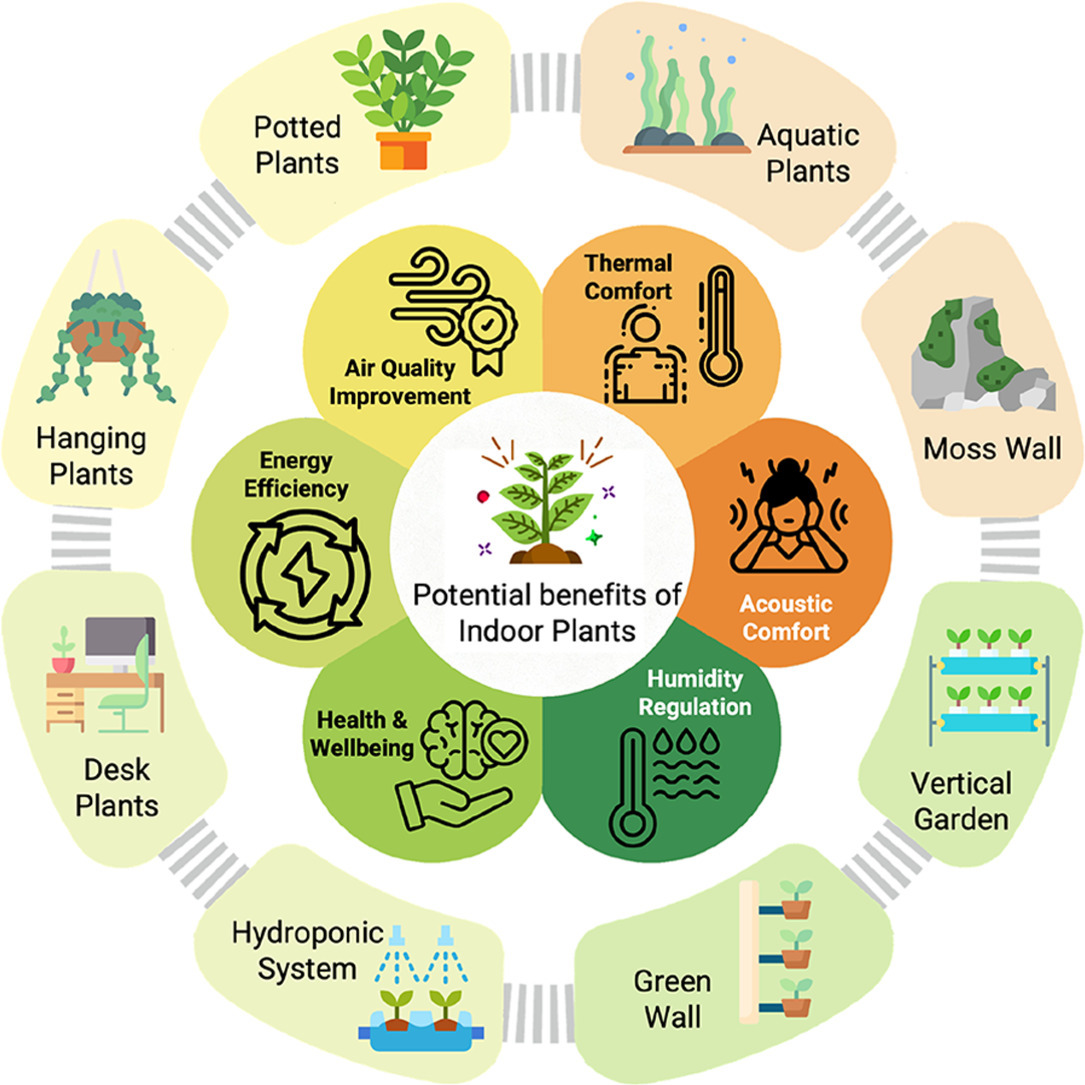
While the benefits of urban green spaces outdoors are well documented, the influence of indoor greenery has remained poorly understood. To address this gap, researchers from 35 institutions across the UK, Europe, the United States, Australia, India and Brazil collaborated through the GREENIN Micro Network Plus project. They developed a ten-question framework to assess evidence across technical, microbiological, health, socio-economic and spatial dimensions.
The team also carried out the first detailed comparison of 26 different indoor greening systems, offering guidance for architects, designers and facilities managers on what works in real buildings – and where evidence is still limited.
The analysis found that larger, engineered plant systems can make indoor spaces feel up to two degrees Celsius cooler and more comfortable, even if the actual air temperature remains unchanged. Some systems were shown to reduce fine particulate matter and volatile organic compounds, although results depended heavily on plant density, lighting conditions and maintenance. There is also early evidence that indoor greenery may enrich the indoor microbiome by introducing beneficial, environmentally derived microbes.
Prashant Kumar, lead author of the study and founder of GCARE said: ‘People spend around 90 per cent of their lives indoors, but surprisingly, we still understand very little about how indoor plant systems can reshape those environments. Our collaborative work shows that indoor greening can make a meaningful difference in certain situations – not just to how buildings feel, but to how they cope with heat, humidity and pollutants.
‘But these benefits don’t happen by accident. They rely on using the right systems, in the right way, with the right lighting and maintenance. Treating greening as environmental infrastructure, rather than decoration, as well as filling substantial research gaps in the topic area, will be key to unlocking its full potential.’
The study cautions that many earlier experiments relied on unrealistic numbers of plants or laboratory chambers that do not reflect everyday homes or offices. The authors call for long-term, real-world studies that account for ventilation, occupancy and upkeep.
Dr Tijana Blanusa, Principal Horticultural Scientist at the Royal Horticultural Society and co-author of the paper, said: ‘Indoor planting is a fantastic way to bring the benefits of plants and people’s interaction with them, into urban homes, schools and any other spaces where nature is not easily accessible. This paper lays strong foundations by providing evidence of the conditions needed to achieve the greatest impact on air quality, wellbeing and more.’
As cities adapt to rising temperatures and air pollution, the researchers argue that indoor greening – properly designed and maintained – could become an important tool in creating more comfortable and climate-resilient buildings.
Photo: vadim kaipov/unsplash
Leave a Reply