

















Sediments at the bottom of rivers and lakes in Mongolia are acting as a hidden archive of pollution, revealing how decades of economic growth have shaped environmental contamination, new research shows.
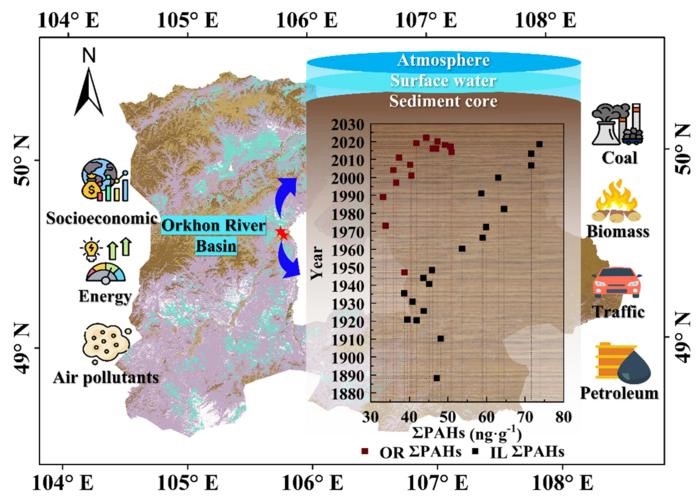
Scientists studying the Orkhon River Basin found that levels of toxic chemicals known as polycyclic aromatic hydrocarbons (PAHs) have risen steadily since the 1940s, closely aligned with the country’s industrial development and energy use.
Source discrimination of sedimentary PAHs in the Orkhon River Basin, Central Asia: a geochemical record of anthropogenic contributions
PAHs are a group of harmful compounds released when fuels such as coal, oil, wood and petrol are burned. They are known to persist in the environment and can pose risks to ecosystems and human health.
By analysing sediment cores – layers of mud that build up over time – researchers were able to reconstruct a historical record of pollution. Using radioactive dating techniques, they showed how PAH concentrations increased in distinct phases that mirror Mongolia’s economic trajectory.
Before the 1990s, pollution levels were relatively low, reflecting limited industrial activity. But from the 1990s onwards, rapid economic growth and rising energy demand drove a sharp increase in contamination. Levels peaked in the period after 2010, coinciding with intensified mining, transport and fossil fuel use.
The study also identified the main sources of this pollution, with leaks and evaporation from petroleum products being the largest contributor, accounting for just over a third of PAHs found in sediments. Coal burning and biomass fuels such as wood each contributed around a quarter, while traffic emissions made up the remainder.
The researchers point out that these pollutants don’t just disappear, they settle into sediments, where they can remain for decades and provide a long-term record of environmental change.
The findings highlight how everyday activities – from heating homes with coal to increased vehicle use – have left a measurable imprint on the natural environment.
The study also found that local conditions play a major role in how pollution builds up. Fine, organic-rich sediments in lakes tend to trap more pollutants, while faster-flowing river systems are more likely to disperse them.
Importantly, the research suggests that tackling this type of pollution will require a combination of approaches. Reducing fossil fuel use, improving vehicle emissions and limiting fuel leaks could all help cut future contamination.
The researchers also found that, unlike other air pollutants, PAH levels are influenced not just by energy use but also by traffic patterns, meaning transport policies could play a key role in reducing pollution.
Overall, the study provides new evidence of how economic development and environmental change are closely linked, and how the legacy of past decisions can remain buried in the landscape for generations.
The full research can be read here.
Image:Shi-Ting Zhai, Jing Chen, Anarmaa Sharkhuu and Tseren-Ochir Soyol-Erdene
Leave a Reply