

















A new scientific review warns that the air inside our homes, schools and workplaces may be a significant source of exposure to a broad range of under-regulated chemicals.
The analysis highlights that while people spend roughly 90% of their time indoors, research and regulation have historically focused on outdoor pollution. The authors from Peking University and Kunming University of Science & Technology argue this gap leaves a major health blind spot.
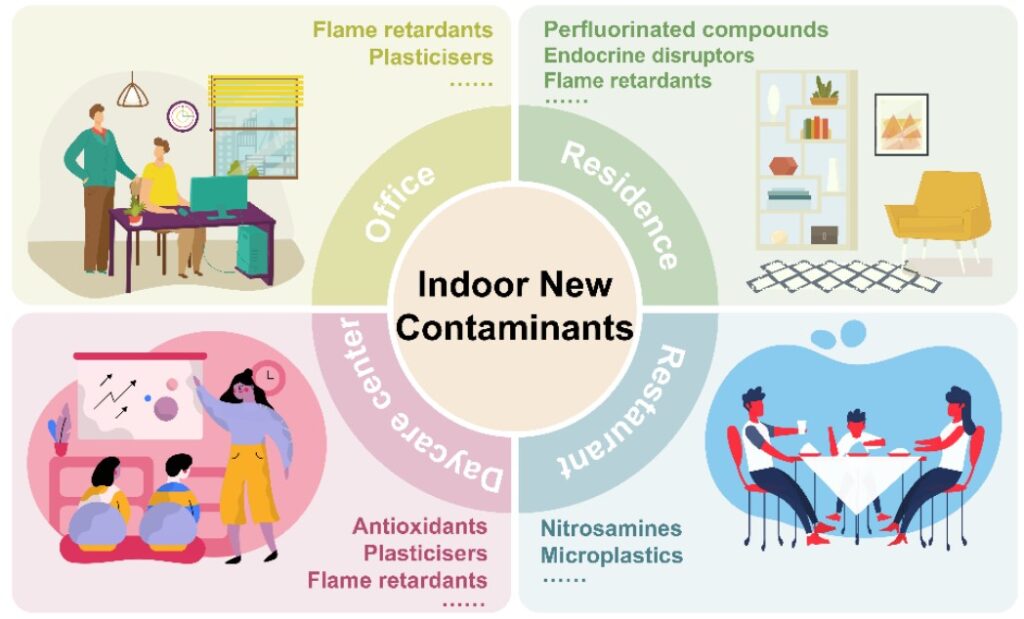
The contaminants in question are not traditional smog or exhaust fumes. They are chemicals like endocrine disruptors from personal care products, plasticisers and flame retardants leaching from furniture and electronics, microplastics from synthetic fabrics, and perfluorinated compounds from non-stick cookware and stain-resistant fabrics. These substances are released into indoor air and dust through everyday use, wear and aging of products.
‘The problem is compounded by modern, energy-efficient buildings which are more airtight,’ the study notes. ‘This allows pollutants from indoor sources to accumulate to levels that sometimes exceed outdoor concentrations, leading to prolonged human exposure.’
A key finding is that different indoor environments have distinct pollution profiles. For example, offices and server rooms are hotspots for flame retardants from electronics, while newly renovated spaces have higher levels of chemicals from building materials. Restaurants and smoking areas may have more nitrosamines.
The study also sounds an alarm about transformation. Once released, these chemicals can react with indoor ozone or light, transforming into secondary products that may be more toxic and persistent than the original compounds.
Corresponding author Wei Du of Kunming University of Science and Technology said: ‘In many buildings indoor pollution can be more severe than what we measure outside and that is especially worrying for children and older adults who rarely leave these environments. Our daily routines bring us into constant contact with chemical residues in the air, dust and on surfaces even when we cannot see or smell them.’
The researchers call for urgent action: systematically mapping pollution in diverse indoor settings, understanding transformation pathways, and conducting health risk assessments. This data is crucial to inform smarter building design, product regulations, and ultimately, to update indoor air quality standards to protect public health from these emerging indoor threats.
Co-corresponding author Bo Pan added: ‘Protecting human health increasingly means looking inward at the places where we live, learn and work and treating indoor environments as a critical frontier for pollution control.’
The full report can be read here.
Illustration: Jinze Wang, Xinyi Zhou, Nan Fu, Shan Zhou, Shuo Yang, Jiangping Liu, Wei Du, & Bo Pan
Photo: Redd Francisco / Unsplash
Leave a Reply