

















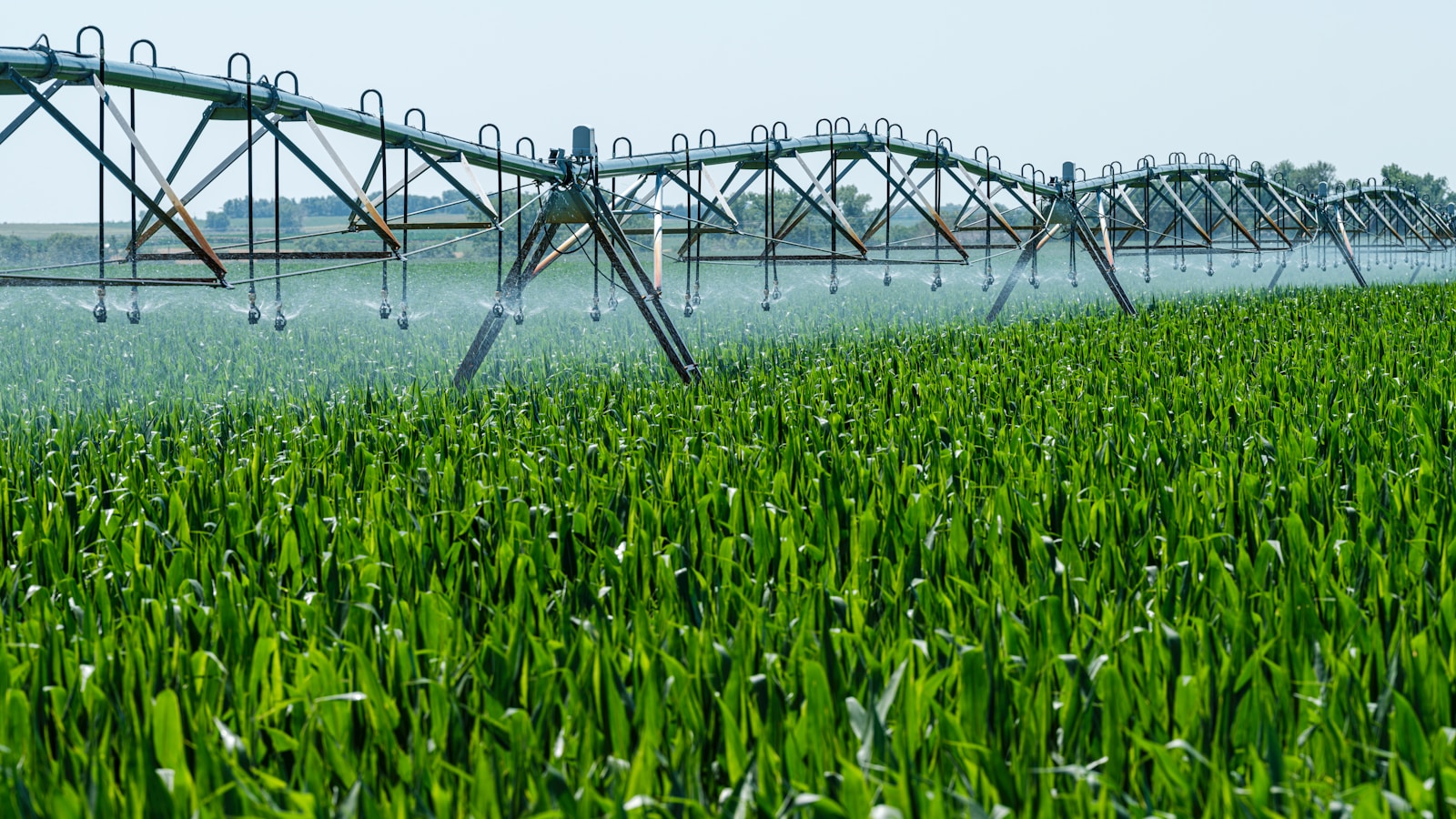
Air quality forecasts used by regulators might be failing to account for an important piece of the puzzle: the effect of watered farmland.
A new NASA-supported study reveals that computer models often fail to account for irrigation, potentially skewing predictions of how heat and pollutants move through the atmosphere.
Researchers from Penn State University compared widely used weather forecasting models against real-world data collected from 16 field sites across California’s San Joaquin Valley and the Mid-Atlantic region. Their goal was to determine if the models properly accounted for the water added to the landscape through farming.
The results showed significant regional differences. The model performed reasonably well in the humid Mid-Atlantic. However, in the San Joaquin Valley, in California’s agricultural heartland, the simulations were significantly off. Because the model does not simulate irrigation, it portrayed watered fields as much hotter and drier than they actually were. It missed the cooling effect of evaporation that occurs when crops are irrigated, particularly during spring and summer daylight hours.
The study found that over irrigated croplands and orchards, the model overestimated daytime sensible heat flux – the heat felt on the ground – by 260 watts per square meter, while underestimating latent heat flux, or evaporative cooling, by 200 watts per square meter. This distortion can have real-world consequences for air quality.
‘Surface fluxes play a pivotal role in shaping the atmospheric boundary layer,’ the authors noted, explaining that these energy exchanges influence how winds develop and how pollutants like ozone and fine particles mix in the air we breathe. When the model’s view of the ground is wrong, its forecast of the air above is compromised.
The research team concluded that integrating space-based observations of vegetation and soil moisture – data that satellites can uniquely provide – could help close these gaps. By updating models to reflect actual agricultural practices, forecasters could produce more accurate air quality alerts.
Photo: Lumin Osity
Leave a Reply