


















A new report argues that floating solar photovoltaics represent a major overlooked opportunity to strengthen the UK’s energy security while generating billions in economic value.
The UK has around 65,000 hectares of water industry and man-made water bodies suitable for floating solar, alongside more than 47,500 hectares of freshwater assets within 5km of urban areas. Unlike ground-mounted solar, which increasingly faces planning opposition over land-use competition and landscape impact, floating solar avoids these tensions by utilising existing reservoirs, quarries and treatment sites.
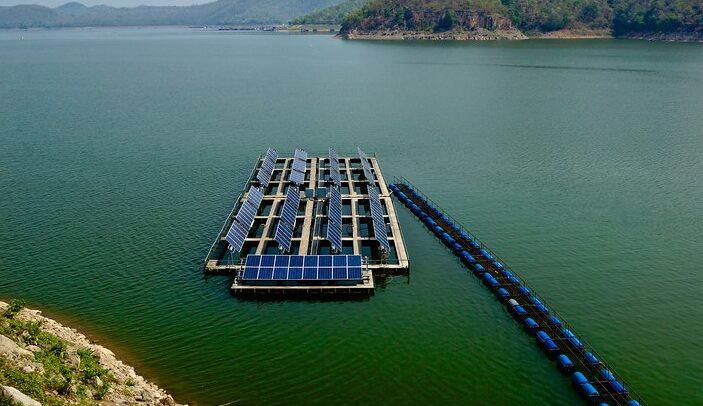
The report, from CBI Economics, commissioned by investment firm Bluefield, looked at potential growth under three policy scenarios: ambitious, moderate government intervention, and without targeted support,
In the middle scenario, it was found that floating solar could scale to:
- 3.6GW by 2030 – enough to power a city the size of Birmingham
- 18.3GW by 2040 – equivalent to the output of around 11 large UK gas power stations
- 40GW+ by 2050 – comparable to the UK’s entire current offshore wind fleet
Under the most ambitious scenario, 58.6GW could be achieved by 2050, with 8.9 gigawatts deployed as early as 2030. Under this pathway, capital expenditure on floating solar could generate over £30 billion in cumulative Gross Value Added and support an average of more than 15,000 full-time equivalent jobs annually between 2027 and 2050. By 2050, operational activities alone could sustain over 16,000 permanent jobs.
The report identifies several policy levers to unlock this potential. Support through the Contracts for Difference mechanism is deemed fundamental to reducing financing costs and accelerating investment.
Planning reform, including Permitted Development Rights for water industry and man-made water bodies, would reduce uncertainty and speed project delivery. Strategic grid designation would ensure ready-to-go projects can connect in a timely manner.
Currently, a typical floating solar project would have an administrative strike price of £106 per megawatt-hour under the CfD framework, compared with £75 for ground-mounted solar. However, the report estimates that under supportive policies, cost parity could be achieved by 2030 in an ambitious scenario, or by the mid-2030s under central assumptions.
Without early intervention, the report warns, the UK risks ceding economic and strategic advantage to international competitors already scaling up floating solar deployment.
Michael Shanks MP, Minister for Energy in the Department for Energy Security and Net Zero, said: ‘It’s time Britain stopped letting our solar potential float on by. For too long, we have failed to harness the huge potential of our reservoirs for floating solar.
‘As this report shows, floating solar could generate the equivalent of around 11 gas power stations by 2040 – cutting our dependence on volatile global gas markets we do not control. In the wake of the conflict with Iran, which has once again exposed the risks of relying on fossil fuels, we are moving further and faster to deliver clean power – protecting bills and making us energy secure.’
The full report can be read here.
Leave a Reply