

















While Europe has made significant progress in reducing particulate matter from traffic, industry and households, a new threat is blowing in from the south. Desert dust transported from the Sahara has increased substantially over the past decade, with concentrations in southern Europe now more than double those in the north, according to new research.
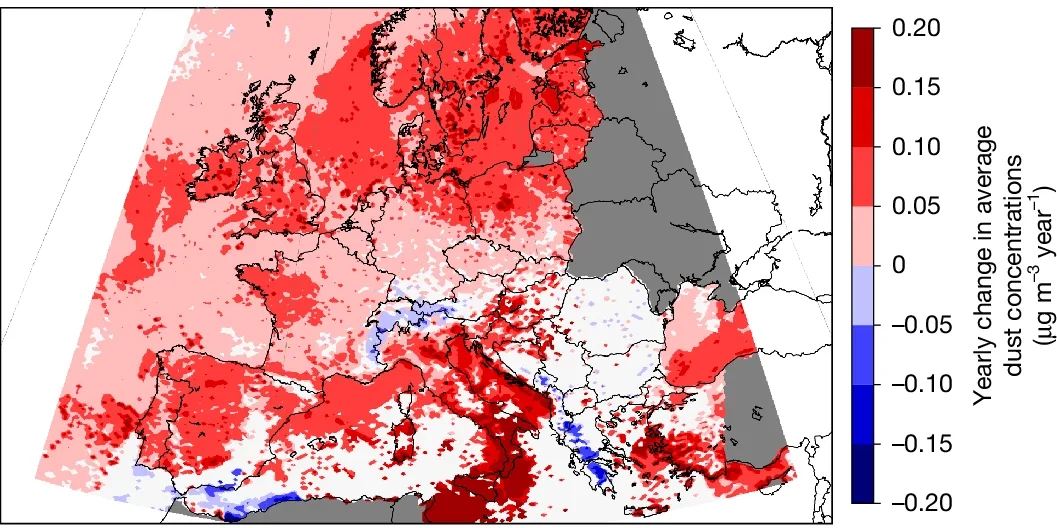
The study, led by scientists at the Paul Scherrer Institute in Switzerland and published with data from more than 100 monitoring stations across Europe, found that average desert dust concentrations in southern Europe stand at 5.3 μg/m³ – more than twice the 2.1 μg/m³ recorded in central and northern regions. Overall, dust levels have risen by approximately 0.5 μg/m³ over the study period, representing an increase of between 10 and 25 per cent.
Project leader Kaspar Dällenbach said: ‘This is not negligible, both in terms of the efficiency and cost-effectiveness of large solar installations and with regard to the health impacts of increased particulate matter pollution.’
To understand the longer-term trend, researchers turned to ice core data from the Colle Gnifetti glacier on the Swiss-Italian border. Dust particles trapped in the Alpine ice over recent centuries reveal that desert dust concentrations have more than doubled over the past 150 years of industrialisation.
The study used aluminium as a reliable chemical marker for desert dust, distinguishing it from other particulate matter sources. While urban construction dust is rich in calcium, and traffic and household emissions contain soot and carbon from combustion, aluminium is characteristic of particles transported from arid desert regions. This allowed the team to determine the origin of ground-level particulate matter with high precision.
The researchers identified the increasing desiccation of the Sahara and changing atmospheric circulation patterns as the primary drivers of rising dust levels. Stronger winds from North Africa are now carrying more dust to Europe than they did a decade ago. While the number of dust storms has not increased, their intensity has grown significantly.
Dällenbach said: ‘It is not yet definitively clear to what extent human-induced climate change has contributed to this development or whether it is further intensifying it. However, our current understanding suggests that the increase in desert dust is at least facilitated by human greenhouse gas emissions and the associated global warming. This leads to drier conditions in certain regions and the expansion of deserts.’
Southern Europe bears the brunt of this pollution, with Greece, Italy, Spain and Portugal particularly affected. Elevated levels were also detected in western France, as air masses from the Sahara often flow out into the Atlantic before turning northwards towards the continent.
On days with elevated dust concentrations, mortality from heart attacks and respiratory problems rises noticeably.
While there is little we can do to prevent the transportation of desert dust, the researchers suggested that comprehensive climate protection measures to limit global warming could, over the long term, help curb the desiccation of desert areas. In the meantime, they proposed establishing warning systems for high dust concentrations, similar to those used for urban air pollution, to allow vulnerable individuals to take precautions.
The energy sector could also benefit from such warnings. Desert dust shades solar panels and accumulates on their surfaces, reducing electricity output. If energy providers could anticipate dusty days, they could compensate by boosting production from other sources, helping to maintain grid stability.
The full research can be read here.
Photo: Dan Page
Leave a Reply