














Islington has once again topped the rankings as London’s healthiest inner borough, securing the title for the sixth consecutive year in the latest Healthy Streets Scorecard.
The annual assessment recognises councils that are leading the way in creating safer, greener, and more accessible streets, encouraging walking, cycling, and other forms of active travel while reducing traffic and improving public spaces.
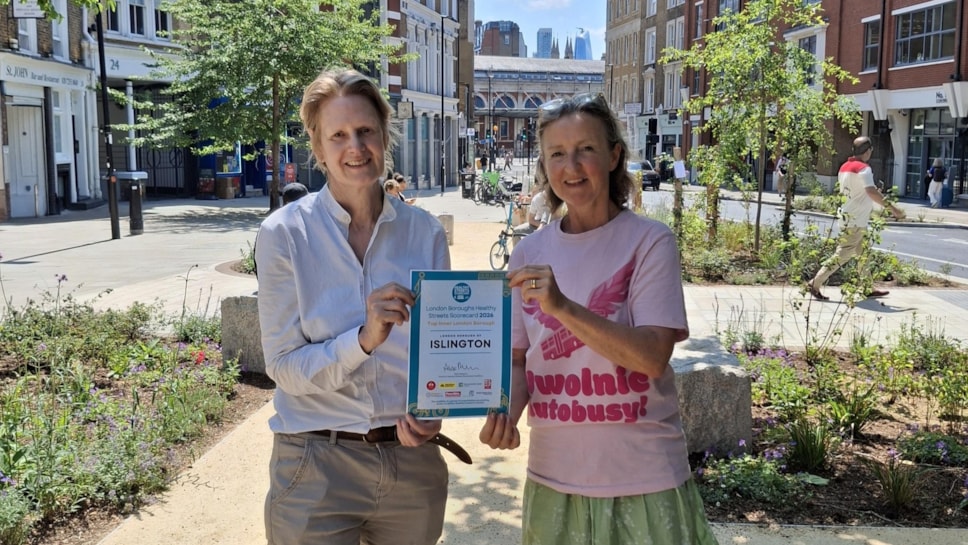
While Islington maintained its crown, Waltham Forest and Enfield emerged as the year’s biggest improvers. Waltham Forest increased its score by 0.30, climbing four places up the rankings, while Enfield’s 0.24-point rise saw it make significant progress. Kingston, Lewisham, and Camden also recorded smaller but notable increases, with Lewisham and Richmond both moving up two places.
At the other end of the table, Barnet and Croydon saw the largest decreases in their overall scores, while Westminster dropped furthest in terms of rank order.
The Scorecard evaluates boroughs against six ‘input indicators’ (Low Traffic Neighbourhoods, 20mph speed limits, Controlled Parking Zones, protected cycle tracks, School Streets and bus priority) along with four ‘outcome indicators’ (sustainable modeshare, active travel rates, road collision casualties, and car ownership) to give each borough a final ranking.
Lewisham and Hackney both added bus priority on 10km of route, while Westminster, Barnet, Islington, and six other boroughs made smaller additions.
LTNs were introduced by Lambeth, Hammersmith & Fulham, Hackney, Camden, and Islington, with increases ranging between 1.6 and 2.9 percentage points. Hackney now leads the way on LTNs with a score of 72.2%, while Bexley languishes at the bottom with just 5.8%.
Coverage of 20mph speed limits improved most significantly in Greenwich and Haringey, which saw increases of 6.9 and 4.7 percentage points respectively. All Inner London boroughs now boast more than 99% coverage.
School Streets saw significant expansion, with Lewisham adding ten, Ealing nine, Newham eight, and both Redbridge and Enfield adding seven. London now has 829 School Streets in total, covering 30% of the capital’s schools. However, Bexley and Hillingdon still have few or no schemes in place.
Protected cycle tracks were expanded in Newham, which added 6km of new infrastructure and saw a 2.0 percentage point increase. The City of London and Southwark both saw decreases due to the removal of protected tracks and improvements in reporting accuracy.
The Scorecard is published annually to track progress and encourage healthy competition among boroughs, with the aim of driving further improvements in the years ahead.
Cllr Una O’Halloran, Leader of Islington Council said: ‘Continuing to top the list of inner London boroughs scored on how healthy our streets are for local people is something we’re really proud of.
‘It shows our dedication to improving air quality and making the borough safer, healthier and more welcoming for everyone.’
Cllr Rowena Champion, Executive Member for Environment, Air Quality, and Transport, said: ‘Healthy streets are about more than simply transport – it is about creating spaces where communities can feel safe and live happier, healthier lives. We’re committed to more environmentally friendly streets, through our tree planting and greening programme including school streets – reducing road danger and making it safer and easier for more people to walk, cycle and wheel.
‘These improvements continue to demonstrate the council’s commitment to tackling and adapting to climate change, delivering greener public spaces for local people, supporting biodiversity, and helping communities adapt to more extreme weather conditions like heatwaves and heavy rainfall.’
The full results can be found here.
Leave a Reply