
















Scientists have uncovered a surprising climate twist from one of the most powerful volcanic eruptions in modern history: a volcano that appeared to clean up some of its own methane pollution.
New research into the 2022 eruption of Hunga Tonga – Hunga Ha’apai volcano has revealed that the underwater volcano not only released vast amounts of methane into the atmosphere but also triggered a natural chemical process that destroyed part of it.
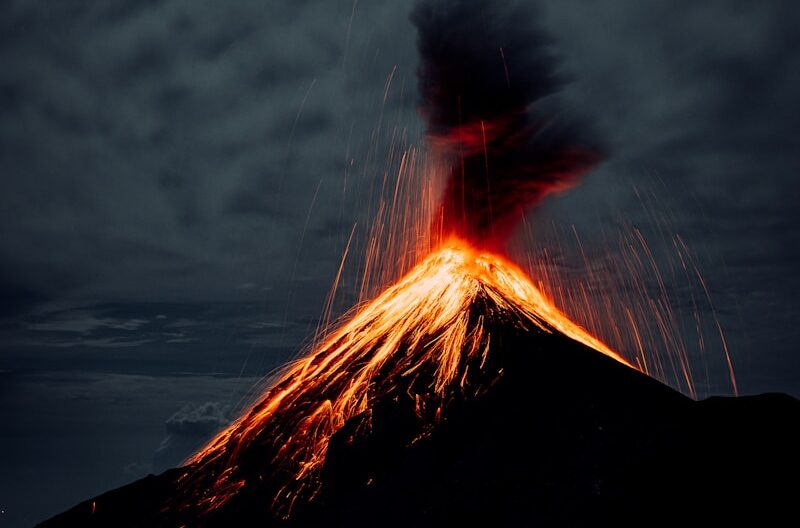
The eruption blasted ash, gas and seawater high into the stratosphere but while analysing satellite data, scientists spotted something unexpected: unusually high concentrations of formaldehyde lingering in the volcanic plume for more than a week.
Formaldehyde is a short-lived byproduct created when methane breaks down in the atmosphere. Its presence at such high levels suggested the plume was continuously destroying methane as it drifted thousands of miles across the Pacific and towards South America.
Dr. Maarten van Herpen from Acacia Impact Innovation BV, first author of the study said: ‘When we analysed the satellite images, we were surprised to see a cloud with a record-high concentration of formaldehyde. We were able to track the cloud for 10 days, all the way to South America. Because formaldehyde only exists for a few hours, this showed that the cloud must have been destroying methane continuously for more than a week,.
‘It is known that volcanoes emit methane during eruptions, but until now it was not known that volcanic ash is also capable of partially cleaning up this pollution.’
The researchers believe the process to be driven by a surprising combination of volcanic ash, salt and sunlight.
The theory is that the eruption hurled enormous quantities of salty seawater into the upper atmosphere, where it mixed with ash particles. When exposed to sunlight, this mixture generated highly reactive chlorine atoms, which react with methane and help break it down in the atmosphere.
The mechanism mirrors a process scientists first identified in Saharan dust clouds over the Atlantic, where iron-rich dust mixes with sea salt to create ‘iron salt aerosols’ capable of producing chlorine.
Professor Matthew Johnson from the Department of Chemistry at the University of Copenhagen said: ‘What is new – and completely surprising – is that the same mechanism appears to occur in a volcanic plume high up in the stratosphere, where the physical conditions are entirely different.’
Methane is one of the most powerful greenhouse gases, responsible for roughly a third of current global warming. Over a 20-year period, it traps around 80 times more heat than carbon dioxide, making it a major target in climate efforts.
Unlike CO2, however, methane remains in the atmosphere for only around a decade, meaning cutting emissions or speeding up its removal could have relatively rapid climate benefits.
The study estimates the volcano emitted around 330 gigagrams of methane during the eruption – roughly equivalent to the annual emissions of more than two million cows – while removing about 900 megagrams per day through this newly observed chemical process.
The team used the TROPOMI instrument aboard the European Space Agency’s Sentinel-5P satellite, which is constantly monitoring air pollution and greenhouse gases around the world’
Matthew Johnson concluded: ‘It’s an obvious idea for industry to try to replicate this natural phenomenon - but only if it can be proven to be safe and effective. Our satellite method could offer a way to help figure out how humans might slow global warming.’
The full research can be read here.
Photo: Jeferson Argueta
Leave a Reply