

















A new sensing technology developed by researchers at TU Wien could dramatically change how scientists track pollution, cutting detection times from days or weeks to just minutes while identifying contaminants at levels as small as a few nanograms or picograms.
The breakthrough system, called EMILIE, uses nanomembranes and infrared light to detect fine particulate matter in air and nanoparticles in water with unprecedented speed and sensitivity. Developed over several years in partnership with spin-off company Invisible-Light Labs, the technology is now commercially available and has already been tested in real-world environmental studies.
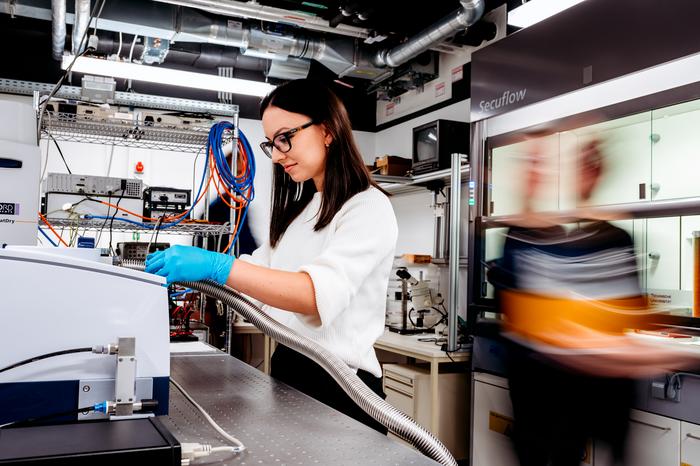
Researchers say the new method could provide a major boost for environmental monitoring, helping scientists better understand pollution patterns and respond faster to emerging threats.
Silvan Schmid, who leads the research team. said: ‘In principle, it is already possible today to detect almost any chemical substance in trace amounts. For example, a sample can be illuminated with many different wavelengths in the infrared range. Different molecules respond to different wavelengths – and from that, we can determine which molecules are present in the sample.’
Traditional infrared detection methods, however, often struggle because they require large amounts of material and can be overwhelmed by background ‘noise’ from other substances.
TU Wien’s solution relies on a microscopic membrane that captures particles and measures tiny heat changes when they absorb infrared light. Those heat shifts alter the membrane’s vibrations, creating a detectable signature.
‘In recent years, we have developed a detection method that makes it possible to reliably measure extremely small quantities of material,’ Schmid said.
The technology has already proven effective in two very different environments: polar air and brewed tea.
In one study, researchers used the sensor to analyse atmospheric aerosols in the Arctic and Antarctic, reducing collection times from weeks to as little as 15 minutes. That speed makes it possible to conduct field studies in remote locations and track changes in airborne particles in near real-time.
Julia Schmale of the Extreme Environments Research Laboratory (EERL) used the sensors on tethered balloons to examine how pollution changes at different altitudes in polar regions.
‘Thanks to the high sensitivity of our method, Julia Schmale’s team can analyse the chemical composition of particles with high temporal resolution,’ said Josiane P. Lafleur. ‘It is now possible… to observe how the chemical composition of aerosol particles changes over short timescales and how it varies between ground level and higher altitudes.’
In another test, the system analysed just 100 nanoliters of tea – about one-thousandth of a drop – and detected not only tea compounds but traces of nylon released from the teabag.
‘We have demonstrated that our method represents a major step forward in environmental analytics,’ Schmid said. ‘Together with Invisible-Light Labs, we now aim to further commercialise this technology and hopefully contribute to more effective environmental protection.’
The full research can be read here
Photo: Romana Maalouf Photography
Leave a Reply