


















Scientists are warning that air pollution may be helping to spread antibiotic resistance through the air, a pathway that has been largely overlooked.
A growing body of research on the ‘air resistome’ suggests that airborne particles can carry antibiotic resistance genes (ARGs), allowing them to travel long distances and potentially enter the human body through inhalation.
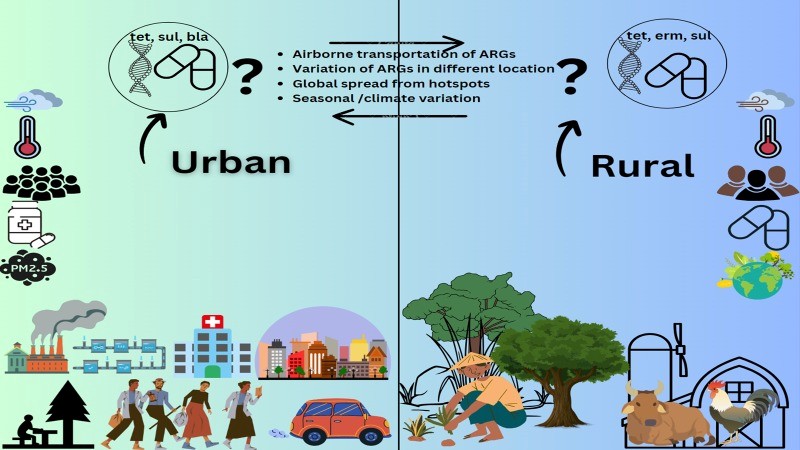
Researchers found that urban pollution and infrastructure shape the air microbiome, releasing clinically relevant ARGs – the kind most likely to reduce the effectiveness of medical treatments – into the air
In a review published in Critical Reviews in Environmental Science and Technology, an international research team has examined how ARGs are distributed across different environments.
The air resistome refers to the collection of resistance genes found in the atmosphere, attached to microscopic particles such as dust, pollution and bioaerosols – tiny airborne droplets that contain bacteria, viruses and other biological material. Scientists say this pathway has been largely overlooked compared with soil and water, despite its potential public health implications.
The researchers noted that bioaerosols can remain in the air for days and travel across regions, raising concerns that antibiotic resistance could spread far beyond its original source.
The review highlights differences between urban and rural air. In cities, airborne resistance genes tend to come from a wide range of sources, including hospitals, traffic emissions, industrial pollution and wastewater treatment plants. These environments often show greater diversity of resistance genes, partly due to dense human activity and pollution.
Rural areas, by contrast, are more strongly influenced by agriculture. The use of antibiotics in livestock farming and the handling of manure can release resistant bacteria into the air, sometimes in large quantities. In some cases, these particles can travel several kilometres from farms into nearby communities.
Air pollution itself appears to play a key role. PM2.5 can act as a carrier for bacteria and resistance genes, helping them survive and spread in the atmosphere. Studies also show that pollution levels, temperature and other environmental factors can shape which microbes and genes are present in the air.
The authors argue that monitoring airborne antibiotic resistance should become part of routine air quality management. Without this, an important route of exposure may be missed.
Professor Fumito Maruyama at Hiroshima University’s The IDEC Institute, who led the team, said: ‘This means every breath we take can potentially connect us to the global challenge of antimicrobial resistance.’
The full research can be read here.
Image: Fumito Maruyama/Hiroshima University
Photo: Charles Chen
Leave a Reply