














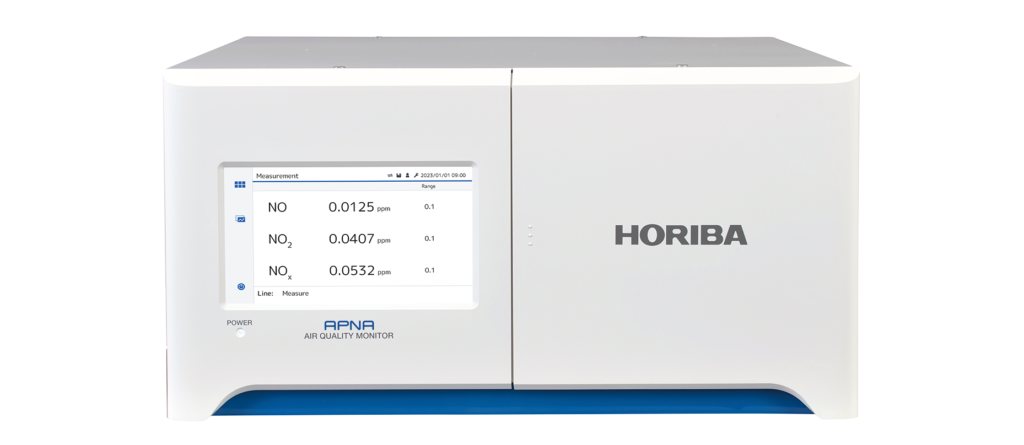



I’ve been having a lot of conversations lately with directors and senior managers about air quality monitoring. The pattern is always the same. They look at the device, they ask about the features, and then they ask the inevitable question: “‘So what?’
It’s a fair question. There are dozens of air quality monitors on the market. Most of them work. Most of them are reasonably priced. Most of them will tell you what’s happening in your building right now.
But a single reading is just a piece of data. It tells you what was happening at one moment in time. It cannot reveal trends, causes, patterns, or what is likely to happen next.
The industry has been focused on the device rather than what the device produces. We’ve been selling the wrong thing.
The Canary Problem
Historically, miners used canaries to detect dangerous air. The canary was a warning system. It only told you one thing, and it told you far too late.
Modern single-reading devices are not fundamentally different. They alert you to a problem that has already occurred. They cannot tell you why it happened, whether it will happen again, or how to prevent it.
Accumulated data over time is the shift from warning system to intelligence system. It’s the difference between a photograph and a film. One captures a moment. The other shows movement, direction, cause and effect.
What Intelligence Actually Looks Like
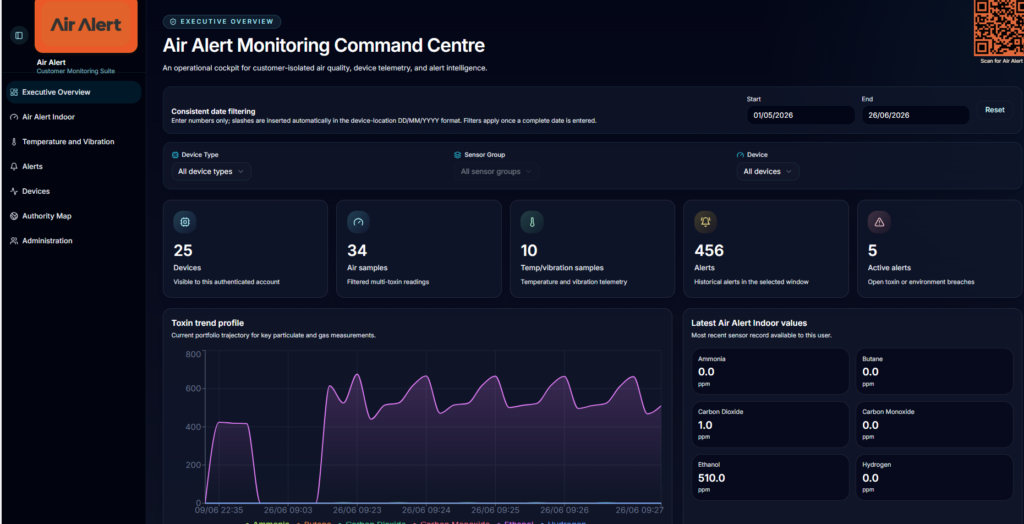
The Air Alert Monitoring Command Centre dashboard illustrates this directly. Across a monitored portfolio, the platform tracks 25 devices producing continuous multi-toxin readings — Ammonia, Butane, Carbon Dioxide, Carbon Monoxide, Ethanol, and Hydrogen — updated every minute and stored over time. In a single filtered window, that translates to 456 historical alerts, with 5 active breaches open at any given moment.
The Toxin Trend Profile chart at the centre of the dashboard tells the real story. It doesn’t show what is happening right now. It shows what has been happening — the peaks, the troughs, the patterns that repeat, the anomalies that stand out. One recent reading showed Ethanol at 510 ppm against a background of near-zero readings for every other substance. A single snapshot of that environment would have shown nothing unusual. The accumulated trend made the anomaly visible and traceable.
That is the difference between a warning system and an intelligence system. The device records the moment. The platform builds the picture.
From Cost to Investment
When I first started talking to potential customers, most of them perceived air quality monitoring as a cost. Something they had to do to stay compliant. A box to tick.
The data reframes it as an investment with a measurable return.
Research shows that CO2 above 1,000 ppm begins to impair cognitive performance in decision-making and problem-solving tasks. This applies in factories, schools, hospitals, and offices. A director who can see that cognitive performance dips every afternoon between two and four, and then traces that back to carbon dioxide levels in a particular room, is no longer having a compliance conversation. They’re having a performance conversation.
When you assess the actual cost of installing monitoring devices against the savings you will make over a period of time through improved productivity, the investment becomes obvious. The data writes its own business case, and it becomes more compelling with every reading it accumulates.
The Data Repository as Differentiator
Anyone can build a device. Nobody can replicate two years of anonymised, pattern-rich intelligence accumulated across real environments.
The data grows more valuable with every reading. It reveals seasonal patterns, occupancy impacts, ventilation failures, and environmental triggers that a single snapshot can never show. This is the differentiator. The device is clever, but it’s just a data collector. The accumulated intelligence is what nobody else has and nobody can fast-follow their way into.
The Geographic Picture
Air Alert’s Authority Map shows device locations plotted across the British Isles — Birmingham, Exeter, Derby, London, and Dublin. It’s an early picture, but an instructive one. These are not the same environments, the same industries, or the same regulatory contexts. A manufacturing facility in the Midlands, a commercial premises in the South West, a site in the capital, and a location across the Irish
Sea in Dublin each produce different data, different patterns, and different baselines.
Aggregated and anonymised, that geographically distributed dataset begins to tell a story that no single device, and no single location, ever could. It starts to describe what indoor air quality actually looks like across different building types, different regions, and different climates. And the moment it crosses a national border, it becomes relevant to a second government, a second regulatory framework, and a second set of policy conversations.
That is not a product feature. That is the beginning of an infrastructure.
The Policy Dimension
There’s another aspect to this that I think is critically important, and one the wider industry has not yet fully grasped. The anonymised, accumulated data held by monitoring companies has enormous potential value beyond the individual customer.
HSE, local authorities, and government bodies are trying to formulate indoor air quality policy. But the data they need doesn’t exist in any structured, continuous form. There are currently no comprehensive indoor air quality standards in the UK, even though outdoor air is heavily regulated. Multiple government departments handle different pollutants independently, with no coordinated approach.
The data is sitting in monitoring company databases. Anonymised and aggregated, it could inform national policy, shape regulatory frameworks, and help define what “safe” actually means across different environments. This positions the monitoring industry not as a supplier of compliance tools, but as a potential contributor to the evidence base that policy is built on.
The device in a Birmingham warehouse becomes a data point in a national health policy conversation. That is a fundamentally different proposition.
Intelligence in Action
Let me give you a concrete example of what this looks like at a community level. We’re currently installing devices in a school and a nearby building in a village where a quarry development is proposed. The data those devices collect could become evidence in a planning objection.
This is what intelligence does that a device never could. It empowers communities to understand and defend their own environment. It creates a baseline. It documents change. It makes the invisible visible and the unmeasured measurable. The people in that village will have an understanding of what is actually happening in their environment — not because someone told them, but because the data showed them.
The Market Is Catching Up
Public awareness of air quality issues has grown considerably, particularly post-COVID. The question in people’s minds has shifted from “does this matter?” to “who do I trust to solve it?”
The answer to that question is not the company with the cleverest device. It’s the company with the accumulated intelligence that proves value over time, that contributes to the policy conversation, and that makes ignorance about indoor air quality genuinely indefensible.
We’re shifting Air Alert’s marketing focus away from devices and towards data accumulation. Because that’s what actually matters. The device gets installed once and runs silently. The data creates a trail that shifts liability from unknown to documented, from reactive to proactive, from cost to investment.
To use an old phrase: it’s the data, stupid.
The whole industry has been staring at the device, while the real value has been sitting in the data stream the whole time. So here’s the question worth sitting with: when you look at your air quality monitoring strategy, are you buying a device — or are you building an intelligence system?
Photo: Adrien
Leave a Reply