












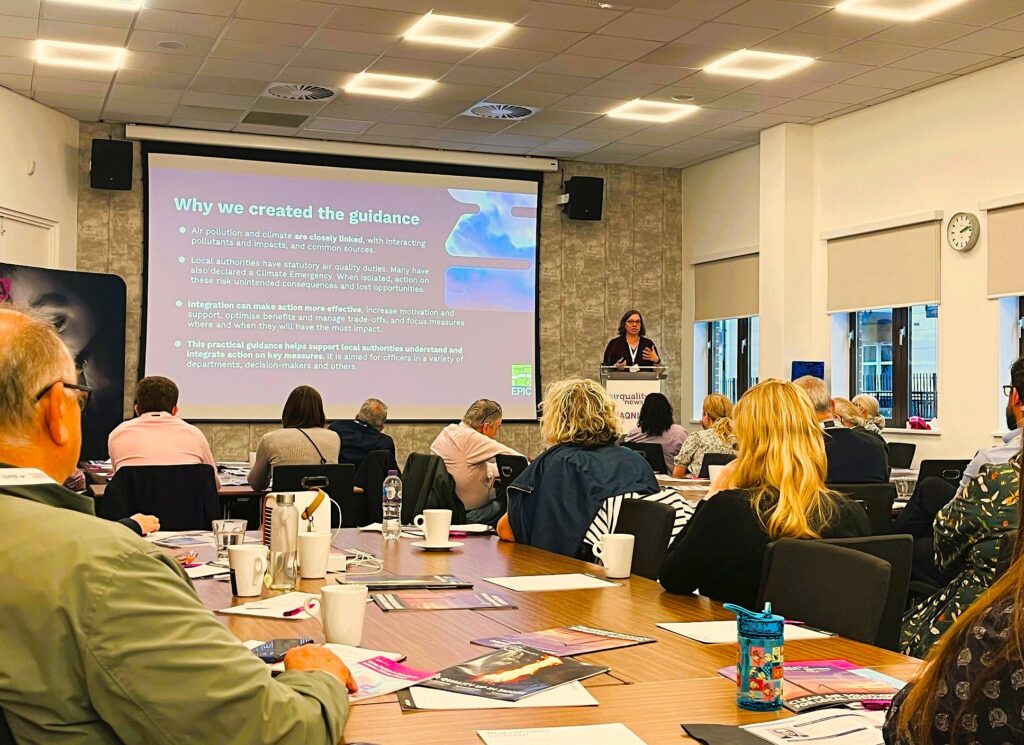


On 25th March we held our 5th Northern Air Quality Conference – and our eleventh conference overall – back at Bridgewater Hall in the heart of Manchester.
Cllr Beverley Nielsen again hosted the event and navigated us through the day seamlessly. The first speaker she introduced us to was Jim McQuaid from the University of Leeds, possibly best known for helping to create Air Quality Stripes.

‘Take us wherever you want’, was the title of Jim’s presentation, prompted by a typically tongue-in-cheek brief from our Editor, Paul Day. Jim took the invitation literally, covering a wide range of issues that continue to affect the air quality agenda.
He began his talk by asking why air quality still struggles to make headlines, despite its major public health impact. Jim noted the 70th anniversary of the Clean Air Act, reflected on the legacy of Ella Adoo-Kissi-Debrah and cited Professor Stephen Holgate, highlighting that 700 of the 870 recognised diseases are now linked to air pollution.
Jim, professor of atmospheric pollution the University of Leeds, called himself a ‘big fan of low-cost sensors’, joking that as a Yorkshireman he doesn’t like spending money – a line that landed well at our Northern conference. He highlighted his ‘Sensing Leeds’ project, working with the council to install air quality sensors on lampposts across the city.
One of his key findings showed sharp pikes in air pollution over bonfire night, a topic he has previously discussed with Air Quality News, which he illustrated via an interactive map.
He closed with a New Yorker cartoon of the proverbial elephant in the room, captioned: ‘I’m right here and no one acknowledges me’. Jim pointed out that air pollution is an obvious, yet overlooked, issue and could be tackled through better data and progress towards net zero.

Following Jim was Chris Hammond, Chief Executive of UK100, an organisation currently celebrating it’s 10th birthday. As such, Chris highlighted the progress local authorities have made in improving air quality over the past decade, arguing that councils remain at the heart of delivering cleaner, healthier communities. He pointed to initiatives such as clean air zones, active travel investment, integrated transport networks and school streets as evidence that local action is producing measurable results.
Chris said the next phase of clean air policy should focus on stronger regional collaboration through devolved authorities, bringing together transport, planning, housing and public health to deliver more coordinated action. He also called for greater attention to indoor air quality, while ensuring buildings are adapted to cope with rising temperatures, pointing out that even newly built schools were forced to close during the recent heatwave.
He also touched on the rise of mis- and dis- information, which risks undermining progress, Hammond urged councils, businesses, community groups and the NHS to work together – even with people you don’t like – to maintain momentum and ensure clean air remains a priority for the next decade.

After the day’s first break, we resumed with the panel discussion, which is always a lively and thought-provoking part of the day.
The panel featured Dr Simon O’Meara, an atmospheric scientist at the University of Manchester whose research focuses on indoor air pollution; Liz Godfrey, Greater Manchester Coordinator for Mums for Lungs, a campaign group working to improve children’s health through cleaner air; Dr Ruaraidh Dobson, founder of South London Scientific and an expert in air quality data and exposure science; Daniell Musaheb, founder of Ardwick Climate Action, whose work centres on community-led environmental initiatives and nature-based solutions and Marina Walker who runs the award-winning What’s The Matter festival which explores air quality, climate and heath through art and community collaboration.
Simon had worked on the INGENOUS project in Bradford and shared with us the work that had gone into one of the UK’s largest and most comprehensive indoor air quality studies, monitoring more than 300 homes in Bradford to better understand how everyday activities such as cooking, cleaning and ventilation affect people’s exposure to harmful pollutants.
Liz talked about the work Mums for Lungs do, particularly around school, driven by an army of volunteers among whom are many parents who have kids with respiratory problems. School streets were brought up and provoked a number of questions from the floor – to be expected given that the North has a paucity of them compared to London.
Ruaraidh continued the theme of engagement, which was a popular theme throughout the whole discussion. His advice was to engage genuinely with the groups you want to talk to and not to rush it. It’s worth building in a lead time to discover what the people want or need.
Marina echoed this, highlighting the importance of co-designing with communities, rather than telling them what to do. Marina has also been campaigning for school streets in London, encouraging children to design posters but at the same time, avoiding coming across as anti-car.
Dan explained that Ardwick in Manchester is penned in by busy arterial roads and can see PM2.5 levels increase by 11 times during rush-hour. To encourage people away from the roads, he has been involved in a project called the Ardwick Stepping Stones, which encourage people to travel through the area via green spaces rather than along the A6. He explained how the group have also been working with the University of Manchester on greening the area.

Following another fabulous lunch – we like to feed our exhibitors and delegates well – Dr Carl Desouza, from the Centre for Low Emission Construction at Imperial College London, took to the stage.
He warned that emissions from the sector will become increasingly significant as road transport becomes cleaner and that construction is already London’s largest source of PM10 emissions, while diesel-powered non-road mobile machinery (NRMM), such as excavators and generators, remains a major contributor to fine particulate matter and nitrogen oxides.
Carl outlined the Centre’s work in monitoring construction emissions, measuring worker exposure to diesel exhaust and developing evidence-based guidance for policymakers and the industry. He said research had shown construction workers face significantly higher exposure to harmful pollutants, reinforcing the need for better emission controls and improved site management.
He also highlighted practical measures to reduce pollution, including dust suppression, cleaner machinery, retrofit technology and anti-idling initiatives, while questioning claims that alternative fuels alone deliver significant air quality benefits. Looking ahead, he argued that stronger national policy, tighter regulation of construction equipment and greater collaboration between government and industry will be essential if the UK is to reduce emissions from the construction sector and meet its wider air quality and net zero ambitions.

Next to the stage was Laura Horsfall, a Principal Research Fellow at University College London, who opened her talk by saying: ‘I’m going to play my Northern card – I’m from the Grimsby area and spent a lot of time with people that smoke which piqued my interest in it.’
Laura specialises in wood burning. She explained that, in theory, tackling the problem should be straightforward, but in practice it is difficult to enforce regulations, particularly when it comes to identifying where it is happening.
Going a step further, Laura’s research has attracted attention by identified where wood burning is taking place at a local scale, showing it is more common in affluent communities. She also found that PM levels were higher in homes when wood stoves were in use, with smaller, less ventilated properties recording two to three times higher concentrations.
She also discussed Energy Performance Certificates (EPCs) as an alternative data source. While they show how a home is heated – she found that nearly 10% used solid fuel – 37% of properties have no EPC rating and cannot be used for calculating wood-burning emissions.
Laura is currently working with Asthma and Health UK on an animation ahead of the upcoming burn season. She highlighted evidence linking wood burning to faster lung function decline, COPD and increased risk of dementia. She hopes it will be ready soon, so keep your eyes peeled.

Following our afternoon break, we welcomed Tore H Rismyhr of Airthings to the stage. Tore highlighted the growing importance of indoor air quality monitoring, arguing that while people consume more air than food or water each day, they often know very little about what they are breathing. He stressed that objective data is essential for understanding indoor environments and making informed decisions about building performance and occupant health.
His presentation focused on the role of multi-sensor technology in measuring pollutants including particulate matter, volatile organic compounds (VOCs), carbon dioxide and radon. Rismyhr described radon as a particularly under-recognised health risk, calling for greater awareness and routine monitoring in homes and public buildings.
Drawing on examples from schools and local authorities in Norway and Canada, he demonstrated how continuous monitoring has helped improve indoor air quality while also reducing energy costs by optimising heating and ventilation systems. He highlighted evidence showing improved classroom environments can reduce staff sickness absence and support better educational outcomes.
Tore concluded that combining real-time monitoring, automated alerts and data analysis enables organisations to improve occupant wellbeing, demonstrate compliance with air quality standards and operate buildings more efficiently, delivering both health and economic benefits.

Last to speak was Jayda David, from the charity Live & Breathe. Jayda talked about how her organisation uses creativity, sport and joyful activities to raise awareness about air pollution in communities that are often overlooked.
She explained that her own introduction to the clean air movement came through poetry, when she was approached by Ella’s mother Rosamund during the Ella Adoo-Kissi-Debrah inquiry to write a poem for the campaign. Researching the facts, she realised her own childhood asthma, which she developed at 12 while living near the A40 flyover, was almost certainly linked to air pollution.
She talked about Live & Breathe’s founder, artist and musician Love Ssega, who was inspired to act after his own experiences living near the South Circular. The charity’s approach, she said, is rooted in the belief that the fight for clean air should be joyful, not just doom and gloom.
She highlighted several partnerships, including a roller skate group for parents with buggies, a youth football club and a community arts collective. The charity funds these groups and documents everything to create a lasting legacy.
Jayda also spoke about recent initiatives: a playful SUV shaming campaign and a vibrant rebrand of London’s ‘Cool Off in Culture’ initiative – encouraging people to use public spaces with air conditioning during heatwaves.
And on that uplifting note, the conference came to a close. We’ d like to thank the speakers and panelists who gave up there time to attend the Northern event yesterday, as well as the exhibitors and sponsors who supported the event. We look forward to working with them again in the future quite possibly at the National Air Quality Conference in London on 11th November.
Super Early Bird tickets for this event went on sale this week.
Leave a Reply