
















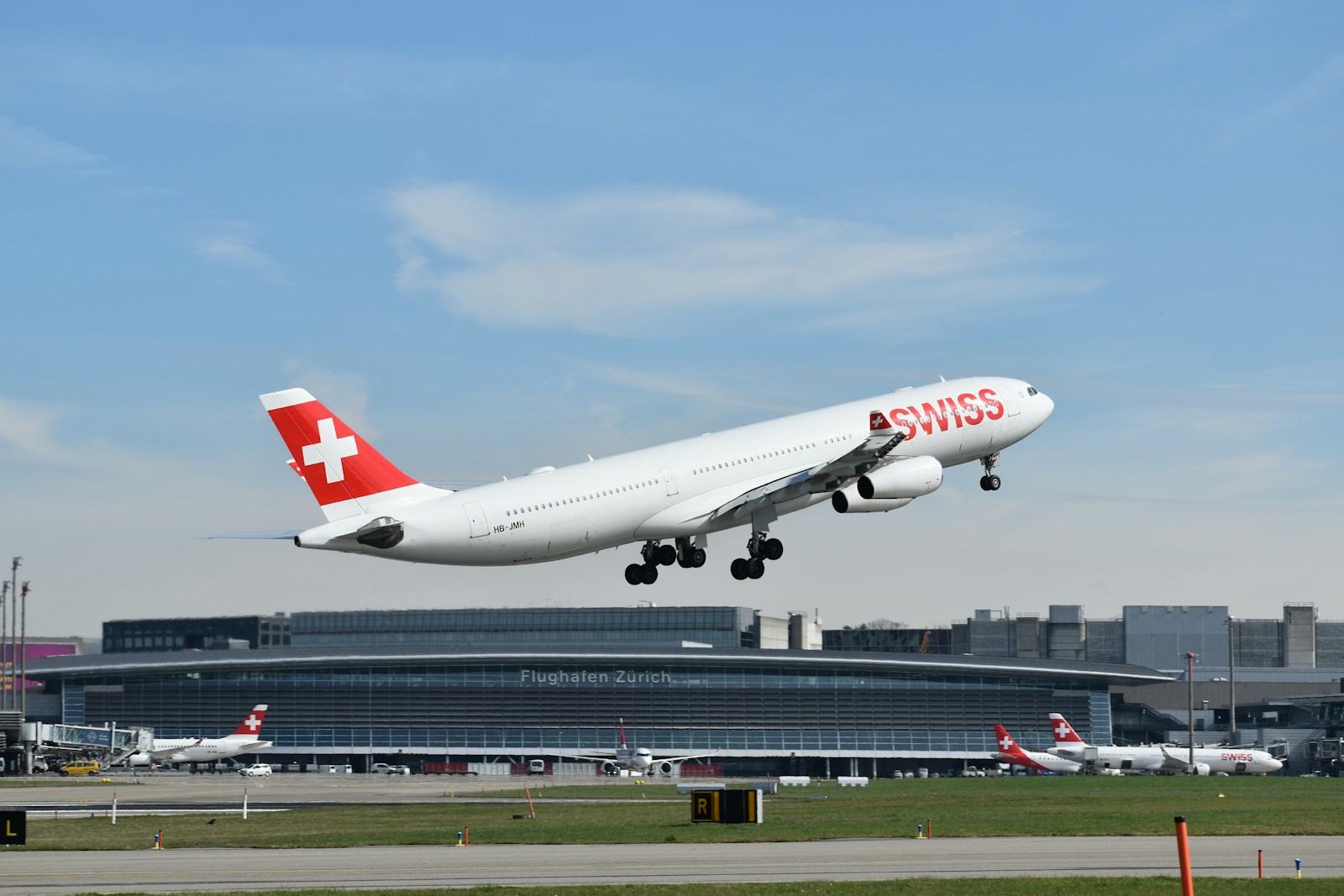
Aircraft taking off and landing at Zurich Airport release huge numbers of ultrafine particles, with levels spiking more than ten times higher than background air, new research has revealed.
Scientists from the Paul Scherrer Institute (PSI) conducted measurements approximately one kilometre downwind of the airport’s busiest runway, during the winter of 2022 and the summer of 2024.
Using specialised equipment that analysed particulate matter in near-real time, they detected up to 300,000 ultrafine particles per cubic centimetre of air, compared to just 30,000 at night when no aircraft were operating.
For the first time, the researchers also detected lubricating oil residue attached to these particles, recorded immediately after planes flew overhead at around 80 to 100 metres altitude. Every passing aircraft triggered a sharp spike in particle concentration.
Study leader Benjamin Brem from the PSI Center for Energy and Environmental Sciences said: ‘A previous study at Frankfurt Airport had already found lubricating oil in the particulate matter. However, in that study, the particles were collected and daily average values were determined. We, on the other hand, recorded measurements of the lubricating oil in real time, that is, immediately after a plane had flown by.’
The particles are a mixture of solid soot and volatile sulphate particles produced during fuel combustion in aircraft turbines and the subsequent cooling of exhaust gas.
While cities typically contain between 5,000 and 40,000 particles per cubic centimetre, mostly larger particles from road traffic, heating systems and industry, the airport’s particles are much smaller, below 100 nanometres. This is significant for human health, as smaller particles can penetrate deeper into the lung’s fine branches.
Study author Sarah Tinorua said: ‘In terms of particle mass, the particulate matter pollution at the airport is lower than in the city. But the number of particles at the airport is significantly higher.
The researchers found that peaks were more pronounced during landings than takeoffs, and stronger winds produced higher particle counts as they prevented particles from clumping together.
Tinorua added. ‘The potential health effects of such lubricants being inhaled deep into the lungs have not yet been fully investigated. As a precautionary measure, it is imperative to eliminate such emissions as much as possible.’
The Swiss Federal Office of Civil Aviation, which funded the study, is already discussing potential measures. These include introducing low-sulphur kerosene, using electric tractors to tow aircraft, and expanding the use of synthetic sustainable aviation fuels, which contain no sulphur and burn more cleanly. Zurich Airport has already banned aircraft auxiliary power units while parked, requiring them to use airport electricity instead.
The full research can be read here.
Photo: David Syphers
Leave a Reply