















A new 100m high facility officially opened today (24th August) at Balruddery Farm in Angus, near Dundee, promising to transform how the UK monitors greenhouse gases and air pollutants.
The Scottish Observatory for Atmospheric Research (SOAR) is the first purpose-built tall tower for scientific research in the country and promises to be one of our most advanced tools in the fight against climate change.
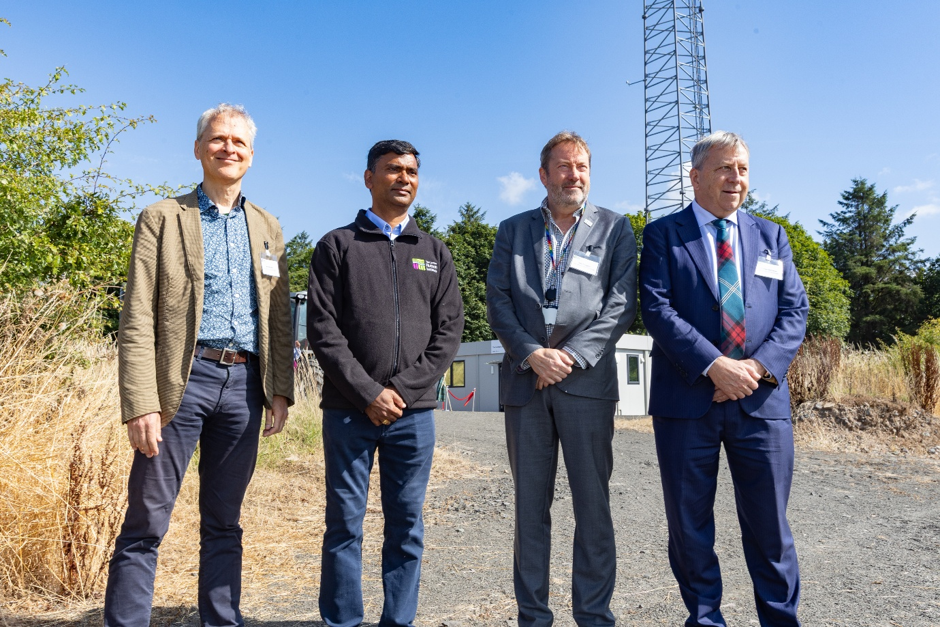
Professor Mathew Williams, Dr Jagadeesh Yeluripati, Professor Colin Campbell and Sir Peter Mathieson
Jointly owned by The James Hutton Institute and the University of Edinburgh, SOAR continuously samples air at both 50m and 100m, using highly sensitive instruments capable of measuring no less than 60 different greenhouse gases, including carbon dioxide, methane, nitrous oxide and hydrofluorocarbons.
Until now, the UK has largely relied on calculations based on activity data and emission factors to estimate its carbon output. These methods carry significant uncertainties. In contrast, SOAR offers direct atmospheric monitoring that provides real-time, highly localised data on where emissions are coming from and how they are changing over time.
Dr Jagadeesh Yeluripati, a senior scientist at the Hutton, said: ‘Greenhouse gas emission estimates largely rely on bottom-up accountancy methodologies, which are associated with significant uncertainties. In contrast, tall-tower atmospheric monitoring provides direct and independent emission estimates. This approach will play a crucial role in reducing bottom-up uncertainties and improving the accuracy and reliability of the estimates.
‘Scotland has one of the most ambitious climate goals in the world, having pledged to achieve net-zero emissions by 2045, so having accurate and trustworthy data is essential for tracking progress and guiding decisions to reach this target.’
SOAR’s location on the east coast of Scotland means it can sample air from the North Atlantic, from the north of the UK and from continental Europe, depending on wind direction, making it uniquely placed to detect regional patterns of emissions that would otherwise go unseen.
Professor Mathew Williams, lead scientist at the University of Edinburgh, said: ‘SOAR’s location in Scotland fills a critical gap for the UK and Europe. It can sample air from the North Atlantic, from the northern UK and from the European continent depending on wind direction. It is already revealing regional patterns of greenhouse gas emissions that help test our understanding and thereby improve our knowledge.’
The tower is particularly significant for Scotland, where agriculture and land use, including peatlands, forestry and livestock, account for a large share of emissions. SOAR will help develop climate-smart farming practices and provide a clearer picture of the true carbon footprint of land-based sectors.
SOAR is part of the UK Deriving Emissions linked to Climate Change (DECC) network and an expanding international network of atmospheric observatories supporting countries in monitoring their emissions under the UN Paris Agreement. The project received a £996,000 capital grant from the Natural Environment Research Council (NERC) in 2021, with the Hutton receiving £567,000 for the build and the University of Edinburgh securing the remainder for equipment. A further £100,000 was granted in 2022 to develop on-site facilities.
Photo: The James Hutton Institute
Leave a Reply